
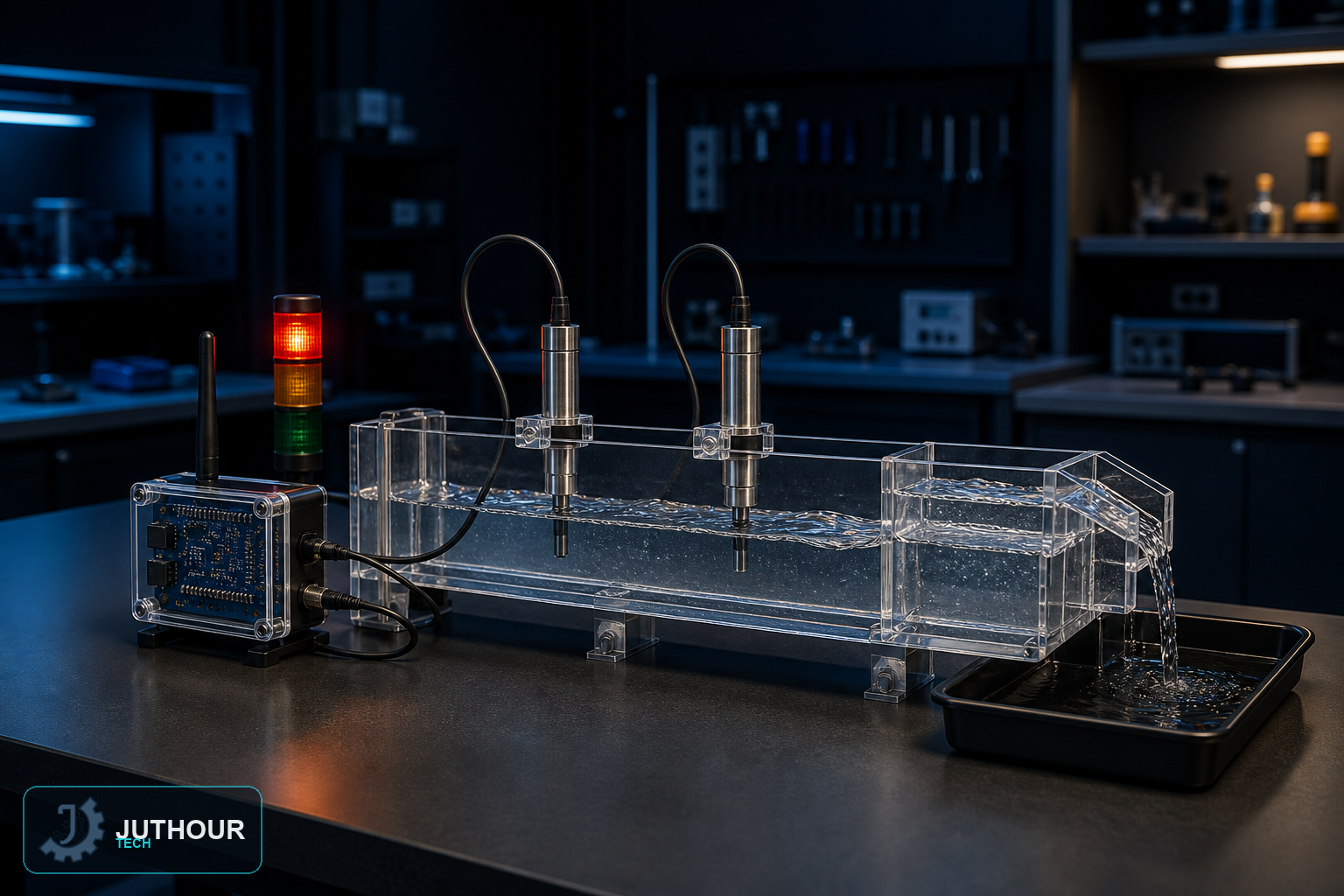
Study water levels on a controlled flume model and show why forecasting, redundancy, communications, and public alerting need dedicated systems.
Prototype objective
The project focuses on sensing, state logic, feedback, and a low-voltage bench prototype that can be tested safely. Define user requirements, success criteria, and failure cases before considering any real deployment.
Suggested components
A Wemos D1 board, a water sensor, an active buzzer, a yellow LED, a breadboard, and jumper wires.
Wiring and implementation
The water sensor connects to pin D4, the buzzer to pin D2, and the LED to pin D1.
Use a regulated supply and common ground, never drive loads directly from controller pins, and add current limiting, suitable interface stages, flyback protection for inductive loads, and logic-level conditioning as required.
Test plan
Use only a guarded scale model. Force blocked, noisy, disconnected, and stale sensor states; test false and missed alarms, power and communication loss, and document independent physical safeguards.
Use limitations
Do not use the prototype for public warnings or life-safety decisions. Flood early warning needs hydrological data, redundant rated stations, resilient communications, authorities, and tested response plans.
Next step
Document the schematic, library versions, calibration, measurements, and failure cases. Whenever the application involves safety, health, children, buildings, or equipment, use qualified specialists and applicable standards rather than relying on a hobby prototype.
Leave your comment