
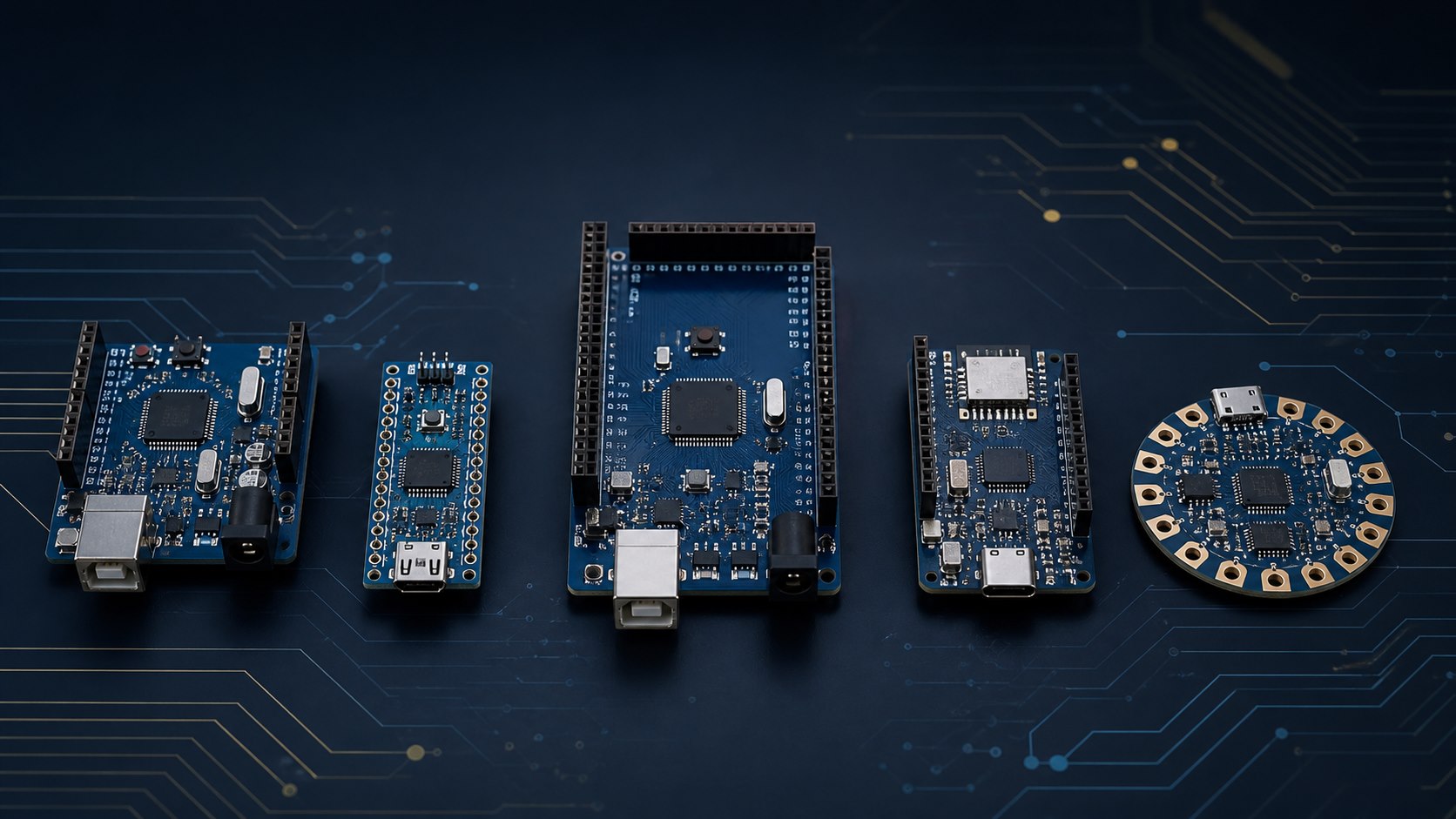
There's no single Arduino board that fits every project - each one has a different nature in terms of size, cost, and the number of pins it offers. In this article we go through the main types of Arduino boards available, and when each one is the right choice.
Arduino Uno
The most famous and most widely used Arduino board by far. The classic through-hole Uno Rev3 uses an ATmega328P in a replaceable socket, while some official variants and compatible boards use a surface-mount package instead. It's the ideal choice for beginners thanks to its simplicity and the huge amount of tutorials written around it.
Arduino Leonardo
A board based on the ATmega32U4, whose native USB interface, notable for its ability to emulate a keyboard or a computer mouse when connected directly to a PC - which makes it a great fit for computer-control projects.
Arduino MEGA 2560
The largest of the common boards, with the highest number of input/output pins. It's used in more complex projects such as 3D printing and robotics that need to control a large number of sensors and motors at the same time.
Arduino Nano
A miniaturized version that carries roughly the same capabilities as the Uno. It's particularly well suited to breadboard experiments and small projects where space is limited.
Arduino Pro Mini
A compact, low-power board without an onboard USB-to-serial converter, useful in space-constrained embedded builds. It requires an external USB-to-serial adapter for programming, so it is slightly less convenient than Uno or Nano for a first project.
LilyPad Arduino
A board designed specifically for integration with fabrics and smart clothing. It can be sewn directly onto fabric using conductive thread instead of traditional wires, and it runs on a lower operating voltage than the other boards.
Choosing the right board ultimately depends on how complex your project is, the space you have available, and your budget. You can compare the different Arduino board types available at Juthour Tech and pick the one that suits your next project. Before buying, verify logic voltage, per-pin current, PWM and ADC channels, Flash and SRAM, USB connector, and bootloader support. A compatible board carrying an Uno or Nano label may not match every detail of an official model. Trusted reference: Official Arduino Uno Rev3 specifications.A quick selection guide
Project need Common choice Learning and general prototyping Uno Small size and breadboard mounting Nano Many I/O pins and hardware serial ports Mega 2560 USB keyboard or mouse emulation Leonardo or another ATmega32U4 board Wearables and conductive thread LilyPad
Leave your comment