
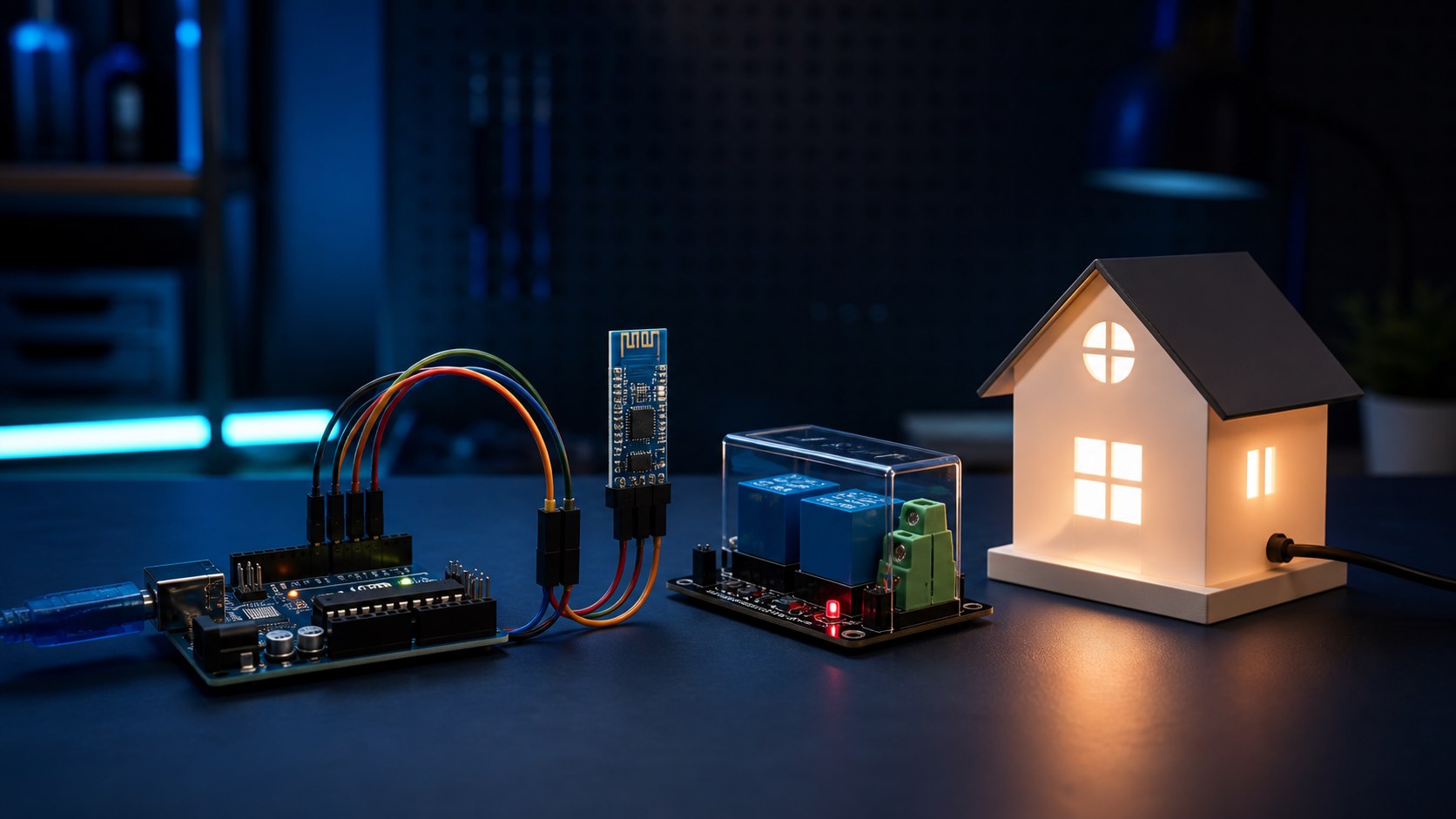
One of the most popular projects Arduino hobbyists start with is remote-controlling home appliances from a mobile phone - a simple build that opens the door to understanding, hands-on, how smart home systems actually work.
What you'll need
The project relies on an Arduino Uno board, an HC-05 Bluetooth module for wireless communication with the phone, a 4-channel relay module to switch appliances on and off, along with connecting wires, a suitable power supply, and an optional LED as a status indicator.
Wiring it up
Power the HC-05 according to the specific breakout board you are using (most boards with an onboard regulator accept 5V), and connect GND to ground. Connect the module TX pin to an Arduino receive pin. The signal going from Arduino to the HC-05 RX pin must be reduced to 3.3V with a suitable voltage divider. Using SoftwareSerial is recommended to avoid conflicts with pins 0 and 1 during sketch uploads. For the relay module, VCC connects to 5V and GND to ground, while its IN1 through IN4 control pins connect to digital pins 4 through 7 respectively.
How it works
The project uses a simple Android app to communicate with the HC-05 module: the user sends a specific character (such as a, b, c, or d) to activate a given relay channel, and sending the same character again turns it off - in other words, the system works on a toggle principle. The Arduino code continuously monitors the serial port, and whenever it recognizes one of the incoming characters, it flips the corresponding digital pin between HIGH and LOW to switch the connected device on or off. Check the voltage and current rating printed on the exact relay module and compare it with the load type; allowable ratings vary. Relay coils may also require a separate regulated 5V supply, wired according to the isolation design of the module.
This project is a small-scale model that illustrates the core idea behind any home automation system, and it can later be extended with a more advanced control app or internet connectivity. Every component in this project - from Arduino boards to relay and Bluetooth modules - is available at Juthour Tech.
Engineering details that prevent failures
- The HC-05 chip uses 3.3V logic at RX; reduce a 5V Arduino TX signal with a suitable divider.
- Many relay modules are active-low. Verify the safe output state during reset before connecting a load.
- Keep power wiring away from signal wiring and use a transistor plus flyback diode when driving a bare relay coil.
- Never route mains wiring through a solderless breadboard or leave COM, NO, and NC terminals exposed.
Leave your comment