
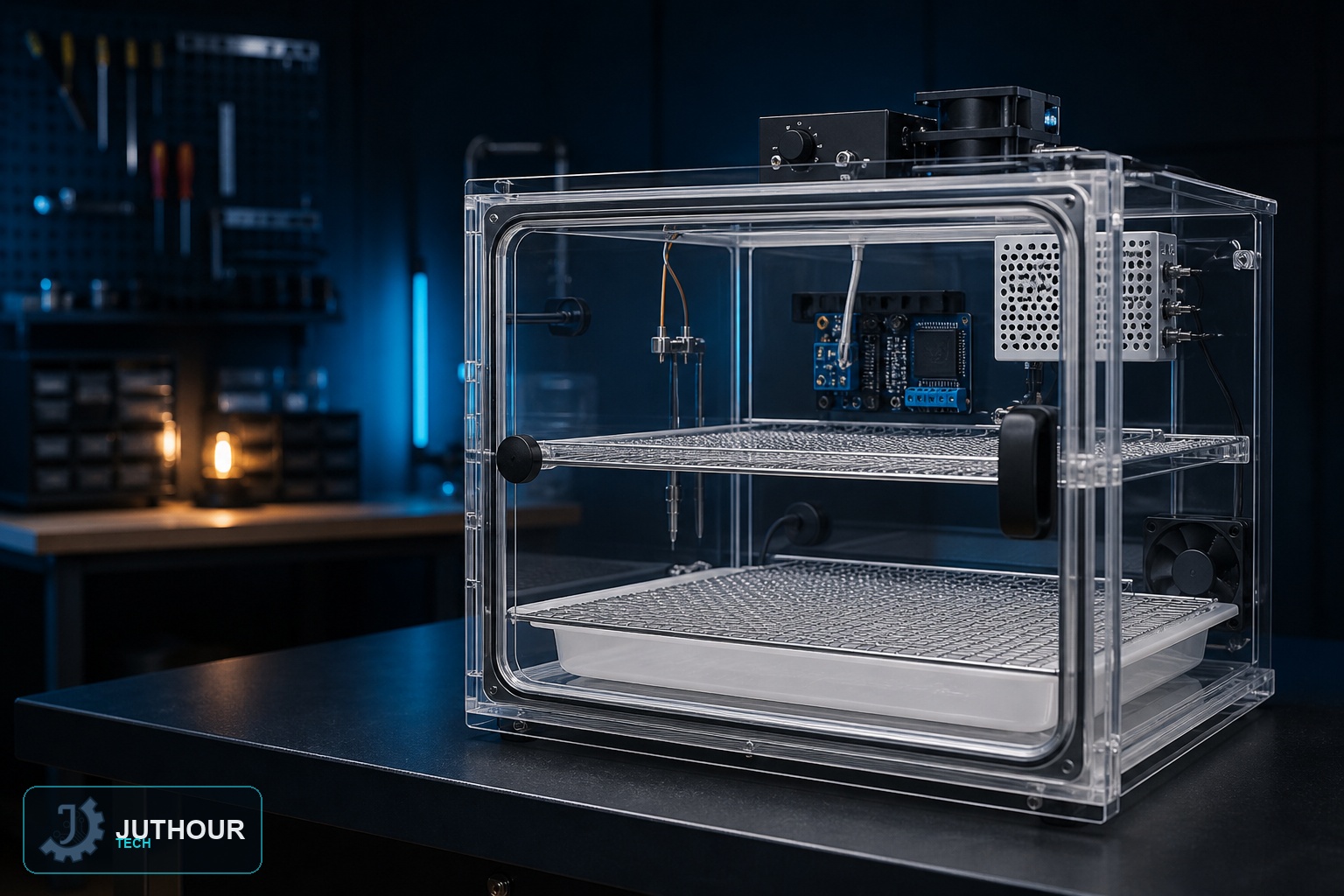
Log chamber temperature and humidity, compare redundant sensors, and demonstrate alarms while a separate thermostat retains control of the heat source.
Prototype objective
The project focuses on sensing, state logic, feedback, and a low-voltage bench prototype that can be tested safely. Define user requirements, success criteria, and failure cases before considering any real deployment.
Suggested components
A Wemos-compatible logger, two temperature sensors, a humidity sensor, independent thermostat and over-temperature cutoff for the test load, local alarm, isolated supply, breadboard, and jumper wires.
Wiring and implementation
Connect monitoring sensors to the logger, but keep the independent thermostat and over-temperature cutoff physically separate in the low-voltage test circuit. The logger may alarm but must not bypass the cutoff.
Use a regulated supply and common ground, never drive loads directly from controller pins, and add current limiting, suitable interface stages, flyback protection for inductive loads, and logic-level conditioning as required.
Test plan
Test minimum and maximum setpoints, hysteresis, actuator travel and stall, sensor disconnection, manual override, restart behavior, and a safe default when power or communication fails.
Use limitations
Do not let a hobby board be the only temperature control for live eggs. Incubation requires species-specific settings, calibrated sensors, over-temperature cutoff, backup power, and husbandry expertise.
Next step
Document the schematic, library versions, calibration, measurements, and failure cases. Whenever the application involves safety, health, children, buildings, or equipment, use qualified specialists and applicable standards rather than relying on a hobby prototype.
Leave your comment