
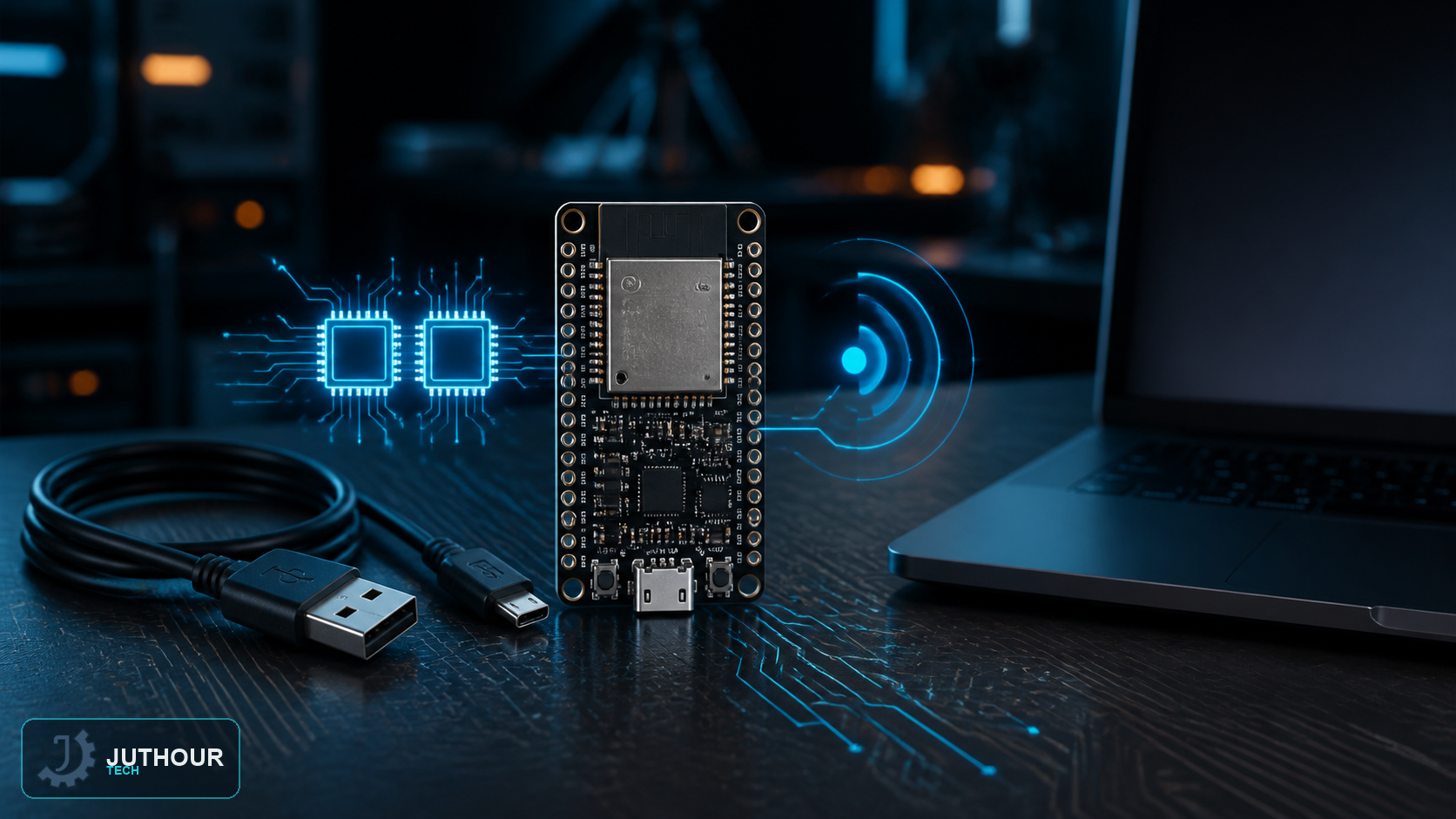
The ESP32 represents the next generation of the popular ESP8266 modules, with far broader processing and connectivity capabilities at a price still within hobbyist reach, making it one of the most widely used IoT controllers in recent years.
Doubled processing power
The ESP32 is built around a dual-core LX6 processor with an adjustable clock speed between 80 and 240MHz, along with 448KB of ROM, 520KB of SRAM, and 4MB of flash memory for storing programs and data — clearly ahead of the ESP8266.
Dual wireless connectivity
The ESP32 supports 802.11 b/g/n WiFi with the ability to act as a standalone access point, in addition to dual-mode Bluetooth combining the classic version with low-energy BLE (4.0), giving considerable flexibility in choosing a connection method for the project.
Pins and operating voltage
The board runs at 3.3V through an onboard regulator supplying up to 600mA, and offers 25 GPIO pins supporting 15 analog-to-digital channels, 2 digital-to-analog channels, 25 PWM channels, 9 touch pads, and support for the UART, SPI, I2C, and I2S protocols.
Programming via Arduino IDE
The board integrates a CP2102 USB-to-UART bridge that connects it directly to a computer for programming and serial monitoring, and simply adding ESP32 board support to Arduino IDE makes programming it just like any traditional Arduino board.
You can find ESP32 boards in various models at Juthour Tech.
Leave your comment