
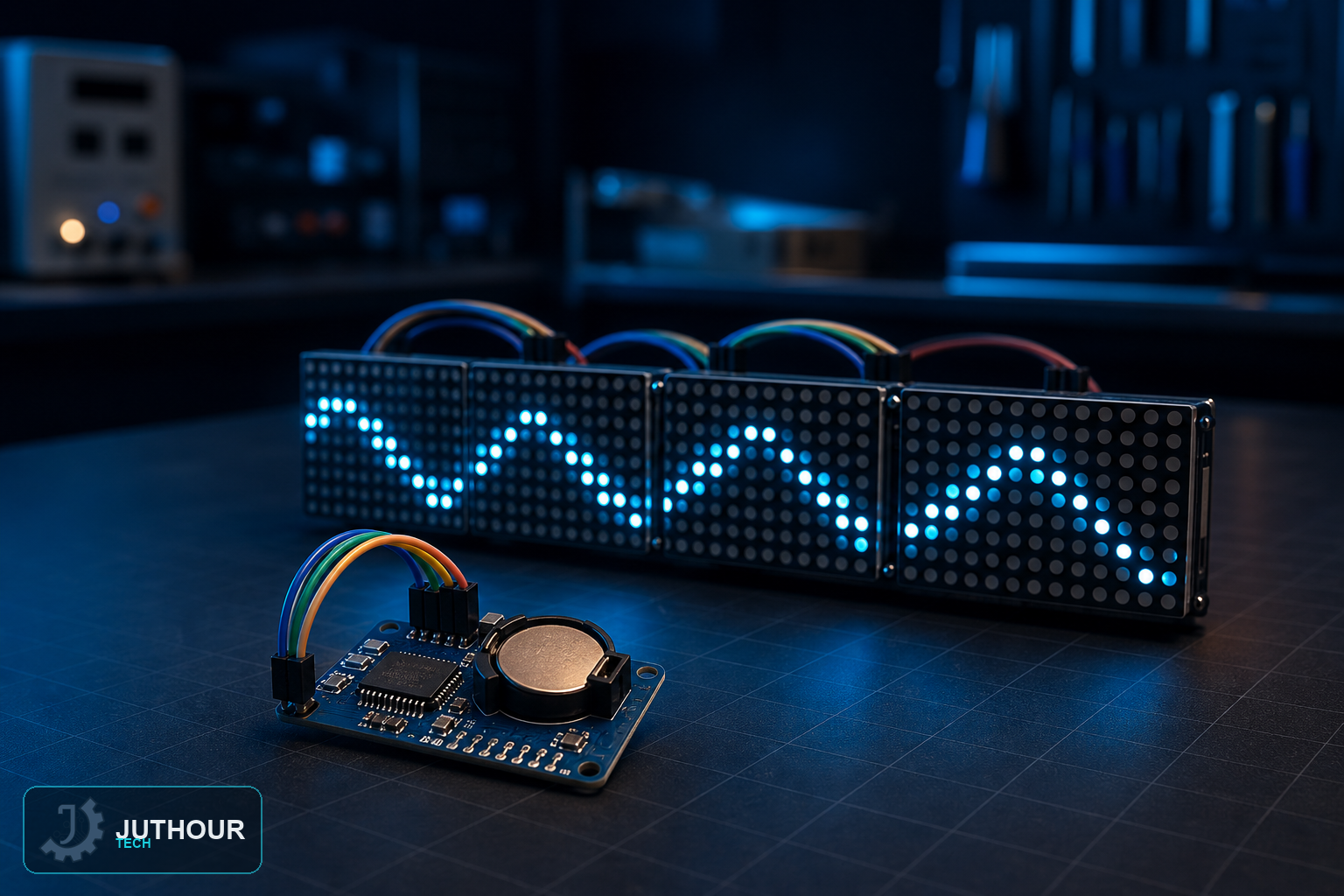
This clock pairs the DS3231 RTC with a row of MAX7219-driven LED matrix modules — a different display technology and a different RTC chip than the DS1307-plus-OLED clock we've built before, giving it a bright, glowing dot-matrix look instead of a small OLED screen.
Why the DS3231 instead of a DS1307
Both are real-time clock chips that keep accurate time on their own backup battery, but the DS3231 adds a built-in temperature-compensated oscillator, making it noticeably more accurate over time than the DS1307 we used in our earlier OLED clock project — worth the small extra cost if long-term timekeeping accuracy matters.
Components needed
An Arduino Nano, a DS3231 RTC module, a 4-in-1 MAX7219 LED matrix display strip, two push buttons labeled "set" and "ent," a breadboard, and a 9V battery.
Wiring it up
The DS3231 communicates over I2C the same way any RTC module does. The MAX7219 matrix strip connects over SPI-style data, clock, and chip-select lines — the same basic wiring pattern as our standalone 8x8 MAX7219 matrix project, just with four modules chained together to display more characters at once.
Setting the time
The two buttons handle configuration: pressing "set" cycles through which value (hours, minutes) is being edited, while "ent" confirms and advances, letting the clock be set entirely from the buttons without needing to reflash the code each time.
How this fits with our other clock and matrix projects
This project combines two things we've covered separately before — RTC-based timekeeping and driving a MAX7219 LED matrix — into one applied clock build, sitting alongside our DS1307/OLED clock as a second complete clock option with a different display style and a more accurate RTC chip.
You can find DS3231 RTC modules and MAX7219 LED matrix displays at Juthour Tech.
Leave your comment