
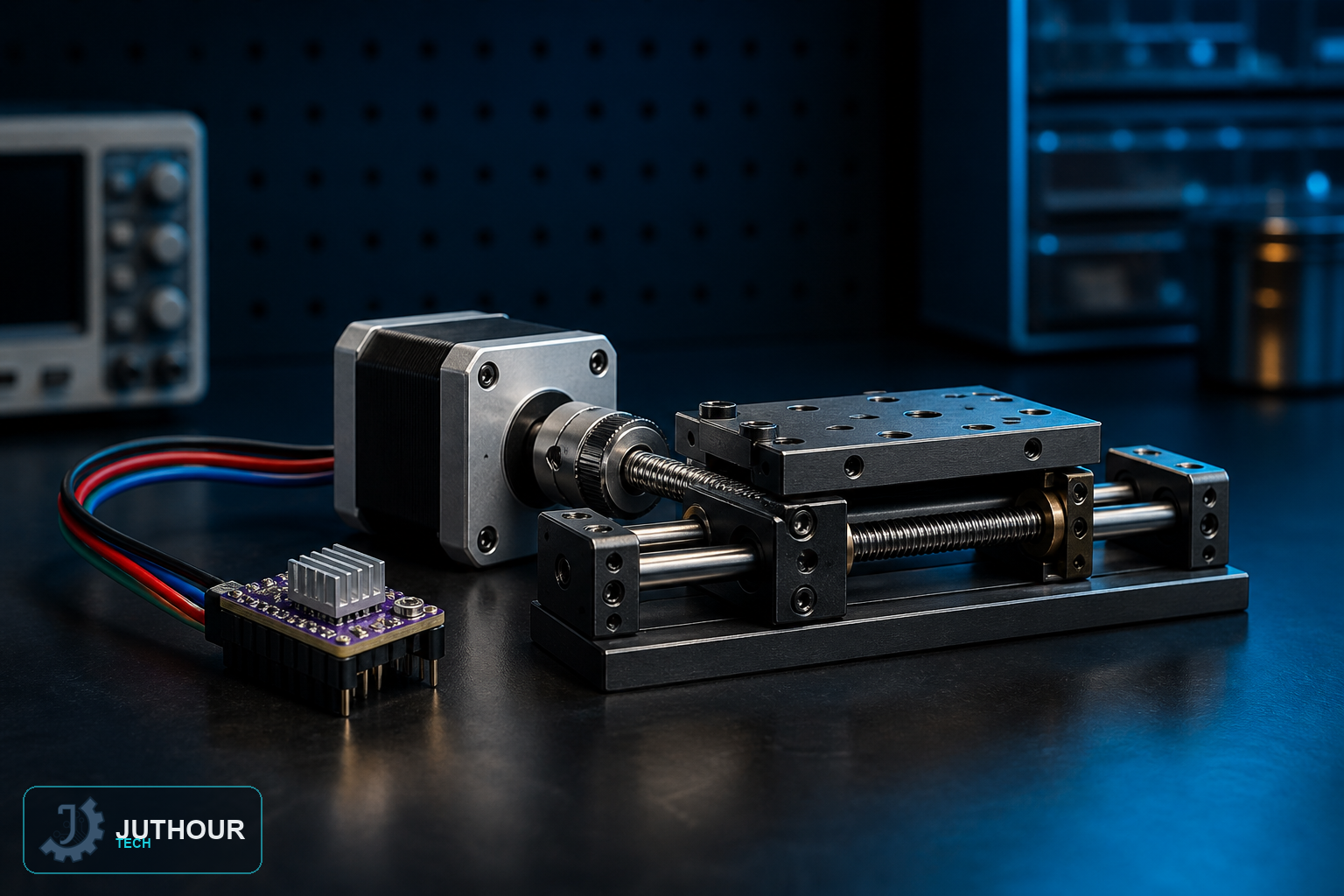
We've already covered driving a NEMA17-class stepper motor with the A4988 driver — this project uses the DRV8825 instead, a very similar-looking driver that handles more current and offers finer microstepping resolution.
How it's different from the A4988
The DRV8825 and A4988 are pin-compatible and wired almost identically, which is part of why they're often interchangeable on the same driver boards. The practical differences are in the specs: the DRV8825 handles higher motor current (useful for larger steppers) and supports finer microstepping — up to 1/32 steps compared to the A4988's 1/16 — giving smoother, quieter rotation at the cost of slightly more heat that typically needs a small heatsink.
Components needed
An Arduino Uno, a DRV8825 stepper driver module, a NEMA17 stepper motor (1.5A, 1.8° per step), a 12V 2A power supply, a 47µF capacitor, and jumper wires.
Wiring it up
The Arduino connects to just two of the driver's control pins: STEP for pulse-based stepping and DIR for direction. The driver itself connects to the NEMA17's coil wires and to the 12V supply, with the capacitor placed across the motor power input to smooth voltage spikes.
Programming it
The AccelStepper library handles acceleration and deceleration curves rather than jumping straight to full speed, which reduces missed steps and mechanical stress. The sketch sets a maximum speed and acceleration, then commands the motor to rotate one full revolution clockwise, pause, and rotate back counterclockwise.
Where this is used
Precise stepper control like this is the backbone of 3D printers, CNC machines, robotic arms, and any project needing accurate, repeatable rotational positioning rather than just continuous spinning.
You can find DRV8825 stepper driver modules and NEMA17 motors at Juthour Tech.
Leave your comment