
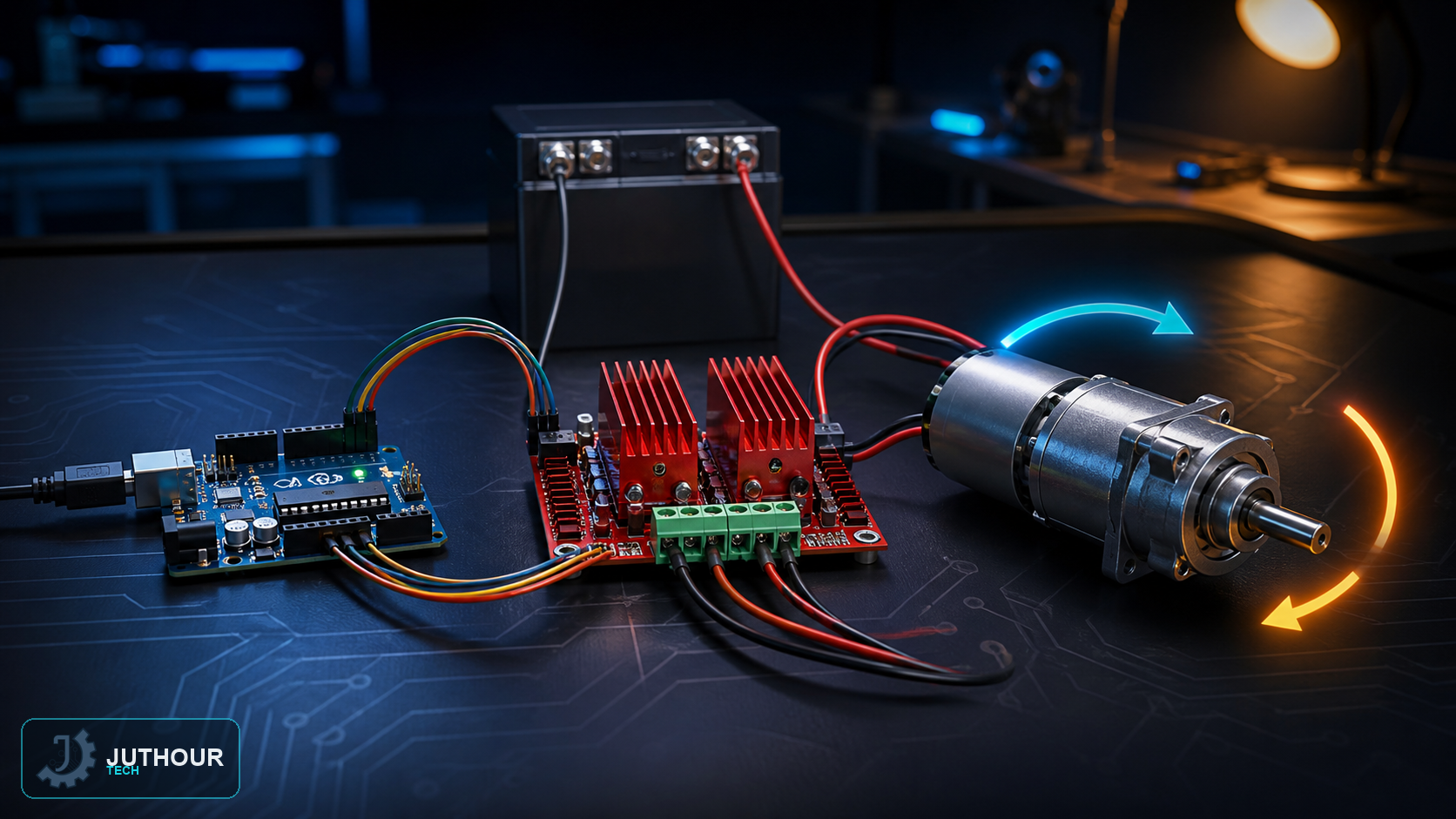
The L298N is used with DC motors more commonly than with stepper motors, thanks to its higher current capacity compared to the L293D chip, making it a popular choice in mobile robotics projects.
Components needed
An Arduino board, an L298N module, one or two DC motors, and an external power supply (5-35V depending on the motor).
Wiring it up
The module is powered through screw terminals at 5-35V, and includes an onboard 78M05 voltage regulator supplying 5V at 0.5A to power Arduino's logic when the 5V jumper is enabled.
The enable pins (9 and 3, both PWM-capable) connect to ENA and ENB for speed control, while the direction pins (8, 7, 5, and 4) connect to IN1 through IN4. Each of the module's two channels can handle up to 2A, with motor outputs on screw terminals: OUT1/OUT2 for channel A and OUT3/OUT4 for channel B.
An important voltage consideration
The module has an internal voltage drop of about 2V, so a 12V supply only delivers about 10V to the motor in practice; it's recommended to add roughly a 2V margin above the motor's rated voltage when choosing a power supply for best performance.
You can find L298N modules and DC motors at Juthour Tech.
Leave your comment