
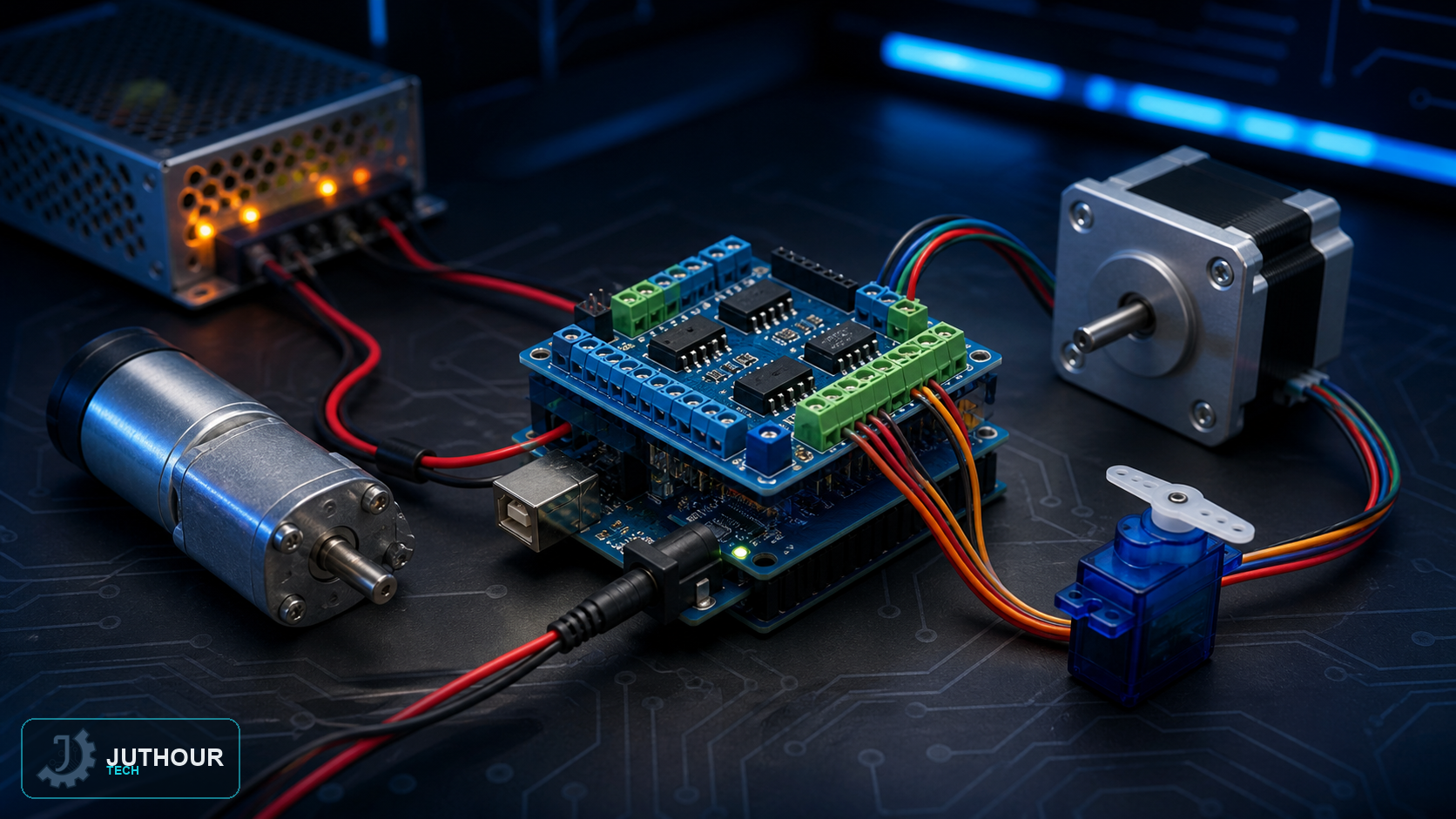
The L293D Motor Driver shield brings three motor types under one control board, able to drive DC, stepper, and servo motors in the same project without wiring separate circuits for each type.
Components needed
An Arduino board, an L293D Motor Driver shield, and the motors to be controlled (DC, stepper, or servo as needed).
Wiring it up
The shield mounts directly onto the Arduino board and contains two integrated L293D chips providing four full H-bridges, plus a 74HC595 chip to expand the number of digital control pins. Digital pins 2 and 13, and analog pins A0 through A5, remain free for other uses in the project.
Control capabilities per motor type
The shield can drive up to four bidirectional DC motors (4.5-25V) with independent speed control per motor via 8-bit values (0-255), two stepper motors (unipolar like the 28BYJ-48 at 5V or bipolar like the NEMA 17 at 12V) with multiple operating modes (Single, Double, Interleave, Microstep), and two servo motors via the shield's dedicated PWM pins, drawing on Arduino's built-in voltage regulator. Each H-bridge delivers up to 0.6A (1.2A peak).
Programming
Control relies on Adafruit's AFMotor library, where a motor object is created for each channel by specifying its port number, then controlled via ready-made functions like setSpeed(), run(), and step(), while servo control uses the standard Servo library through the directly available PWM pins.
You can find the L293D Motor Driver shield at Juthour Tech.
Leave your comment