
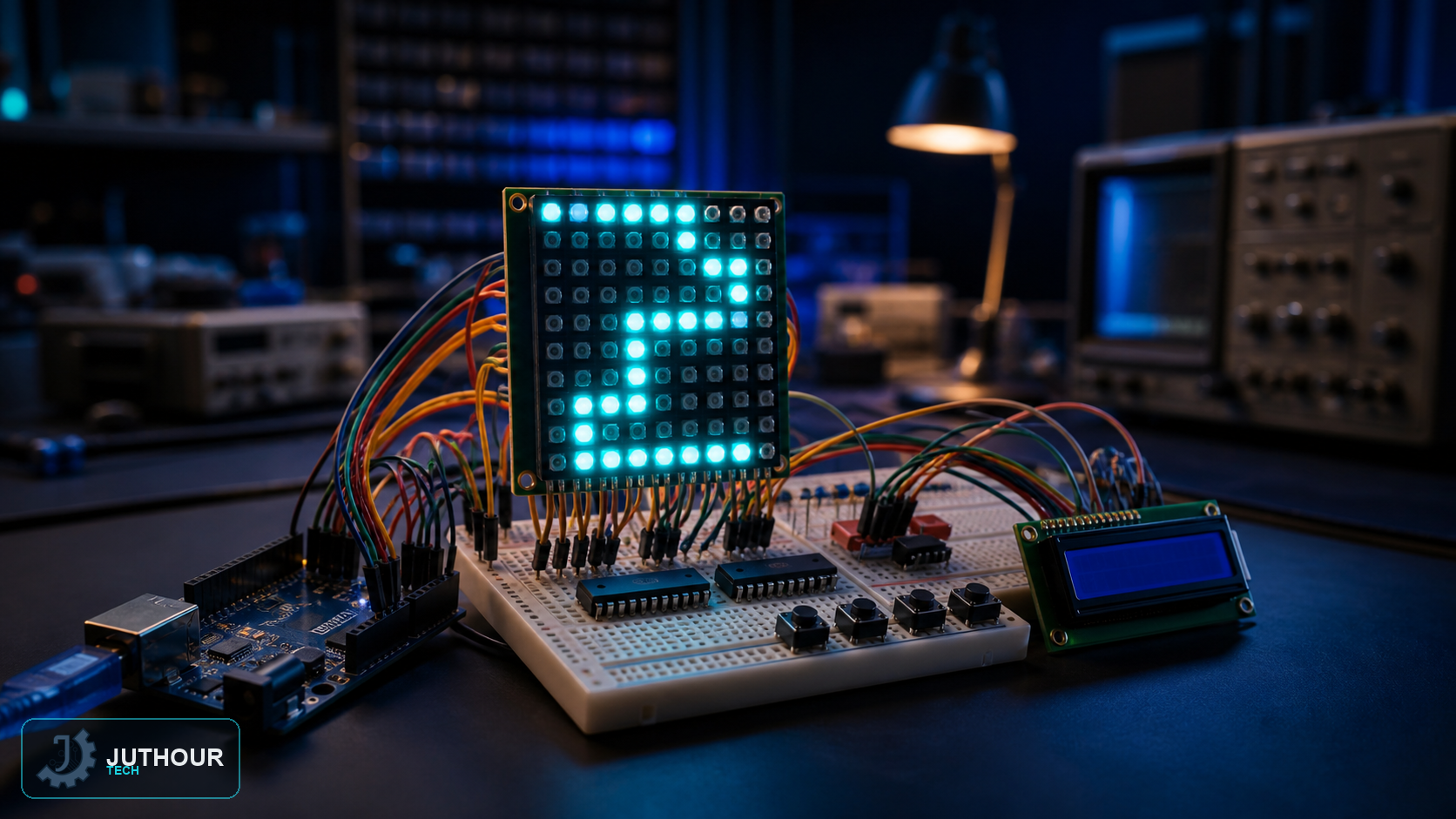
Our earlier 8x8 matrix article used a ready-made MAX7219 driver module to keep the wiring simple; this Snake game project takes the more hands-on route, driving the same style of 8x8 dot-matrix display directly with a pair of 74HC595 shift registers instead — good practice in exactly the row/column multiplexing the MAX7219 normally hides.
Components needed
An Arduino Uno, an 8x8 red LED dot-matrix display, two 74HC595 shift registers (one for rows, one for columns), a 16x2 LCD display for the score, five push buttons (four directions plus start/reset), a potentiometer for LCD contrast, a breadboard, and connecting wires.
How the shift registers drive the display
The display is multiplexed across rows and columns, but every 74HC595 output and the package have current limits. Add segment resistors and transistor drivers where required, account for common-anode versus common-cathode mapping, and avoid long delays so refresh remains stable.
How the game plays
The snake starts moving upward automatically, and the five buttons steer it in the four directions plus restart the game. Eating a piece of food adds five points to the score (shown on the LCD) and extends the snake's length by one segment. The game ends the moment the snake's head touches the edge of the 8x8 display.
Rising difficulty
Each time the snake eats, its movement speed increases slightly, so the challenge escalates naturally as the score climbs rather than staying at a fixed difficulty throughout.
You can find 8x8 dot-matrix displays and 74HC595 shift registers at Juthour Tech.
Leave your comment