
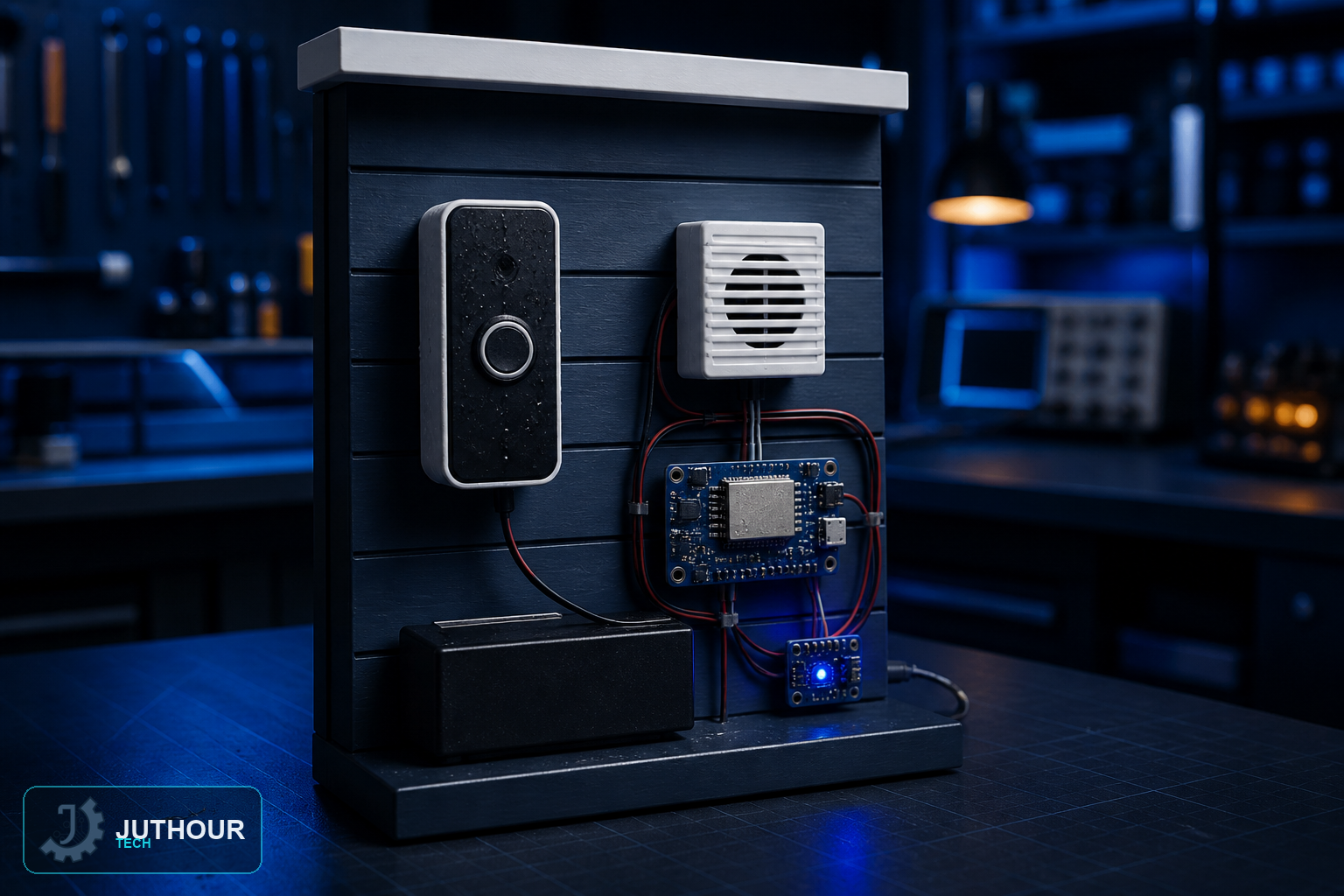
Build a button-triggered doorbell notifier with debounce, local chime, delivery acknowledgement, quiet hours, and graceful behavior when Wi-Fi is unavailable.
Prototype objective
The project focuses on sensing, state logic, feedback, and a low-voltage bench prototype that can be tested safely. Define user requirements, success criteria, and failure cases before considering any real deployment.
Suggested components
A Wemos-compatible board, a weatherproof low-voltage doorbell pushbutton, local chime or buzzer through a suitable driver, status light, regulated supply, breadboard, and jumper wires.
Wiring and implementation
Connect the pushbutton to a protected digital input with debounce, drive the local chime through a transistor or suitable module, and keep local ringing functional even when Wi-Fi is unavailable.
Use a regulated supply and common ground, never drive loads directly from controller pins, and add current limiting, suitable interface stages, flyback protection for inductive loads, and logic-level conditioning as required.
Test plan
Test debounce, short and long activation, a stuck or disconnected switch, accidental presses, acknowledgement, retry and escalation timing, battery state, network loss, and a local fallback.
Use limitations
A doorbell should keep working locally when the network fails. Protect visitor privacy, avoid unnecessary recording, weatherproof exterior parts, and use compliant power supplies.
Next step
Document the schematic, library versions, calibration, measurements, and failure cases. Whenever the application involves safety, health, children, buildings, or equipment, use qualified specialists and applicable standards rather than relying on a hobby prototype.
Leave your comment