
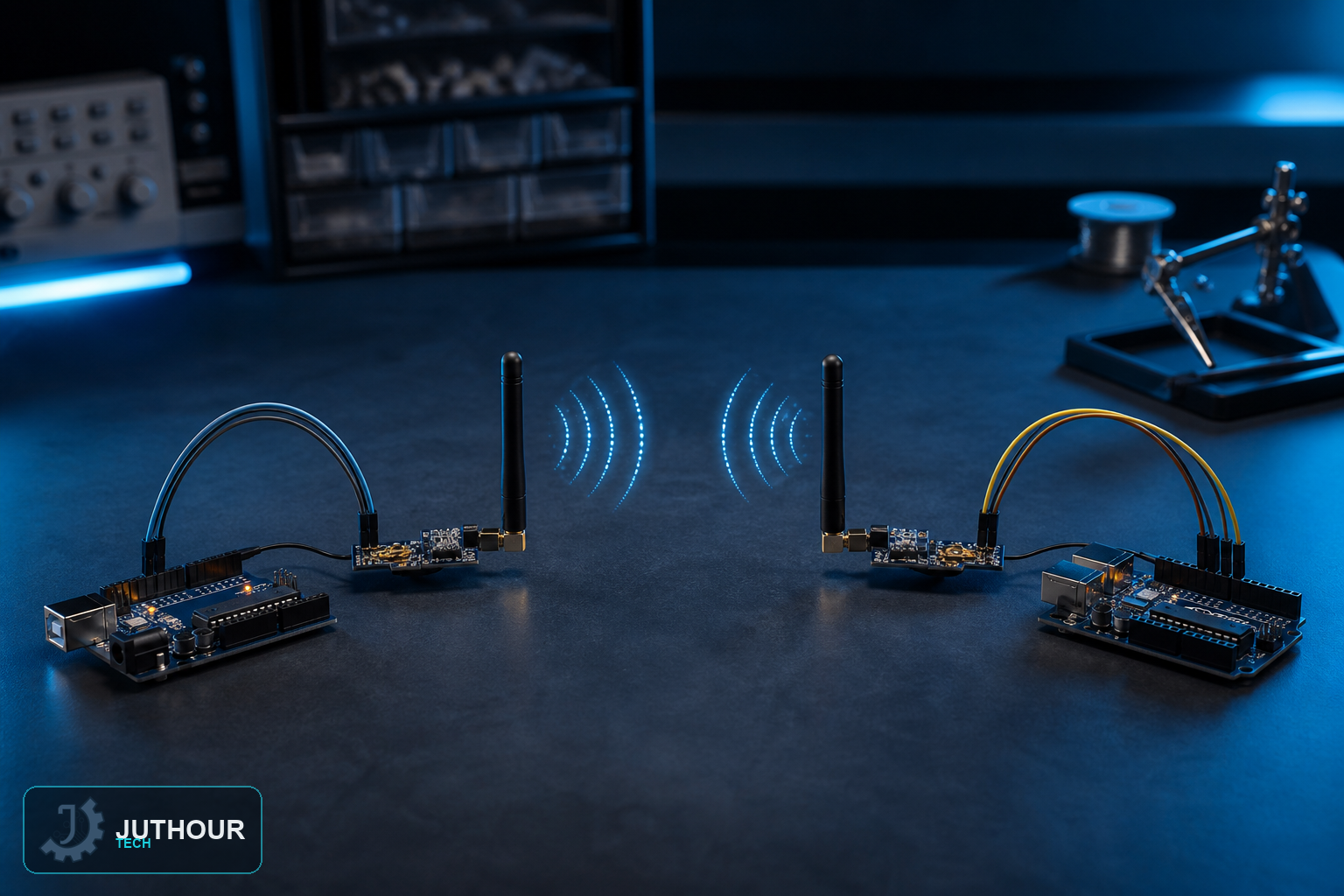
The NRF24L01 does something the RF 433MHz modules we've covered before can't: it's a true two-way transceiver, meaning the same module can both send and receive over a reliable 2.4GHz digital link, rather than only broadcasting one-way like a simple ASK/OOK transmitter.
How it works
The module communicates over the 2.4GHz ISM band using SPI, giving it a much more structured, packet-based communication style than the simple on/off radio bursts of an RF 433MHz transmitter/receiver pair — which makes it noticeably more reliable for exchanging real data rather than just simple remote-trigger signals.
Components needed
Two Arduino boards (commonly Nano), two NRF24L01 modules, a 3.3V voltage regulator or adapter board for each module (since the NRF24L01 needs 3.3V while Arduino runs at 5V), breadboards, and jumper wires.
Wiring it up
Each module connects over SPI, with its CE pin to Arduino pin 9 and CSN to pin 10, alongside the standard SPI data lines. Because the module is 3.3V-only, powering it directly from Arduino's 5V rail would damage it — a dedicated 3.3V supply or regulator is required.
Programming it
Using the RF24 library, one Arduino is programmed as a transmitter, sending data packets addressed to the receiving module's address, while the second Arduino runs receiver code that listens for those packets and prints whatever it captures to the Serial Monitor.
How this compares to RF 433MHz
The RF 433MHz modules we covered before are simple, cheap, one-way transmitters best suited to short trigger signals. The NRF24L01 costs a bit more but supports genuine two-way communication, longer and more structured data packets, and — since it's addressable — the ability to build small networks of multiple nodes talking to each other rather than a single sender-to-receiver pair.
Where this is used
This makes the NRF24L01 well suited for remote-control projects that need acknowledgment or two-way data, and simple home-automation setups linking several Arduino nodes together wirelessly.
You can find NRF24L01 wireless transceiver modules at Juthour Tech.
Leave your comment