
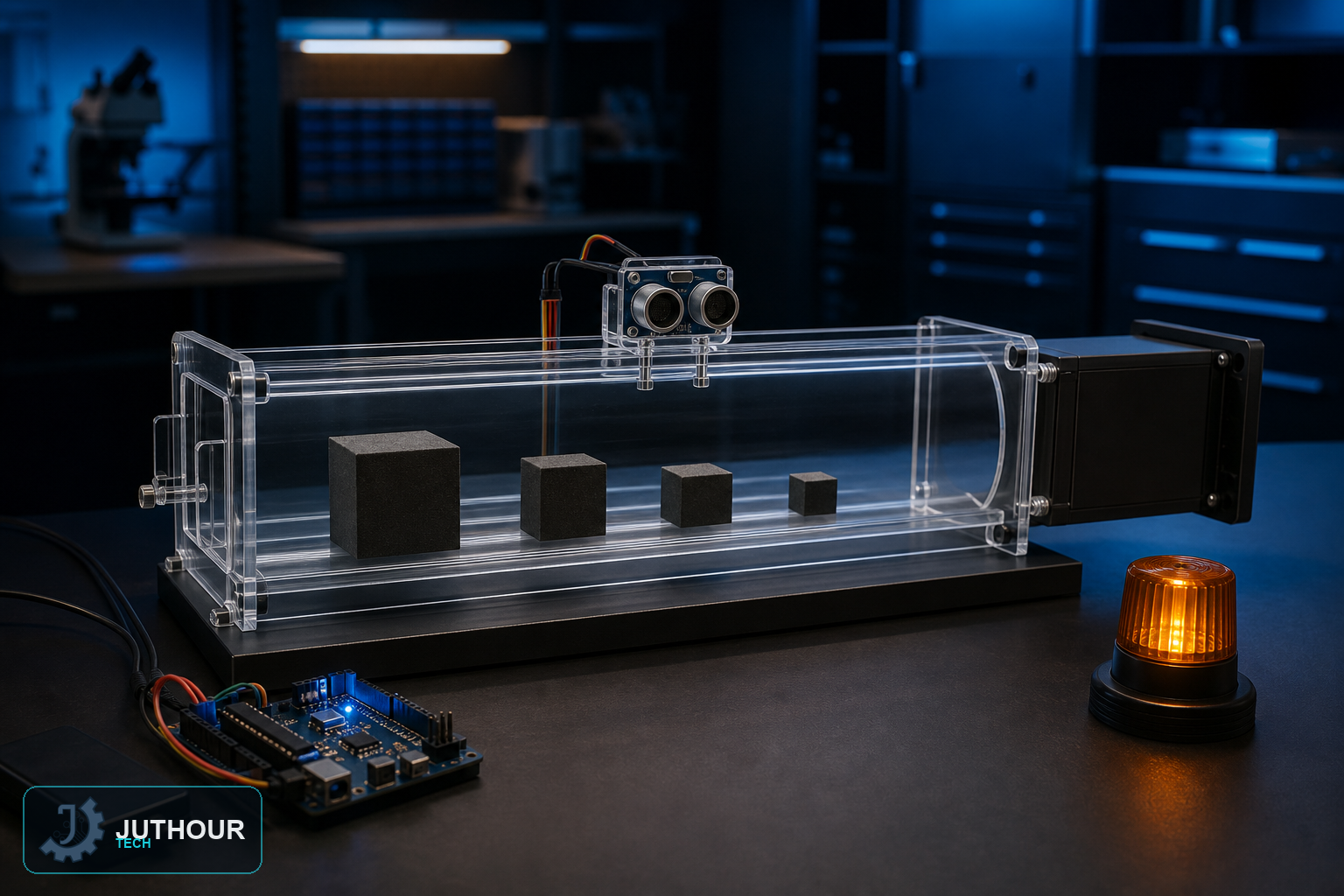
Evaluate short-range movement detection at a model opening and measure false triggers from objects, pets, dust, and changing surroundings.
Prototype objective
The project focuses on sensing, state logic, feedback, and a low-voltage bench prototype that can be tested safely. Define user requirements, success criteria, and failure cases before considering any real deployment.
Suggested components
An Arduino Uno, an HC-SR04 ultrasonic sensor, an active buzzer, a yellow LED, a breadboard, and jumper wires.
Wiring and implementation
The HC-SR04's Trig and Echo pins connect to pins 12 and 13, the buzzer to pin 3, and the LED to pin 4.
Use a regulated supply and common ground, never drive loads directly from controller pins, and add current limiting, suitable interface stages, flyback protection for inductive loads, and logic-level conditioning as required.
Test plan
Use varied target sizes and speeds, test angled movement, insects, pets, vibration, dust, sensor blockage, temperature change, and long idle periods; log false and missed events.
Use limitations
Detection does not identify species or solve an infestation. Seal entry points, protect food, maintain sanitation, and use qualified pest-control guidance where needed.
Next step
Document the schematic, library versions, calibration, measurements, and failure cases. Whenever the application involves safety, health, children, buildings, or equipment, use qualified specialists and applicable standards rather than relying on a hobby prototype.
Leave your comment