
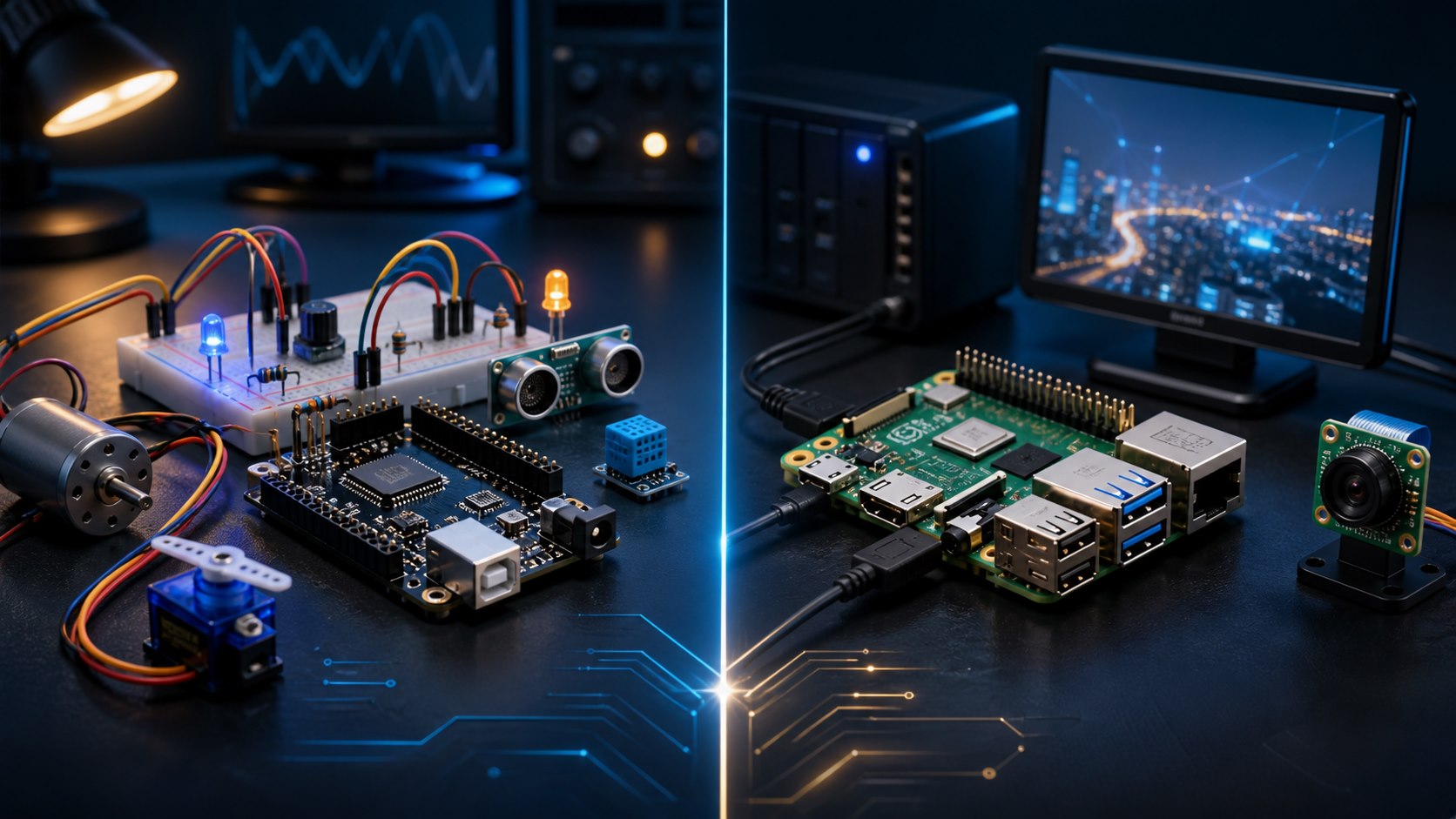
One of the most common questions among newcomers to electronics and embedded computing is: should I start with Arduino or Raspberry Pi? The truth is the two devices aren't really competitors so much as tools that serve different purposes, and understanding the difference saves a lot of time and money.
The core architectural difference
Arduino boards are built around microcontrollers that run a dedicated program and interact directly with input/output pins. Raspberry Pi is a single-board computer built around a system-on-chip (SoC) and runs a full operating system. It needs storage and a power supply, but it can operate headlessly without a keyboard or display.
Computing power and operating system
Modern Raspberry Pi boards provide multicore processors and enough memory to run Linux and multiple applications, while Arduino boards prioritize direct, deterministic control with far fewer resources and don't run a conventional operating system at all - just a single dedicated program uploaded directly to the chip.
Programming languages and setup requirements
Raspberry Pi can be programmed in multiple languages such as Python, Java, C/C++, and Ruby, and it can run with a desktop interface or headlessly over a network without a local screen, keyboard, or mouse. Arduino, by contrast, only needs a simple USB connection to a computer to upload code, usually written in a language close to C++.
When should you choose each one?
If your project centers on directly controlling sensors, motors, and electrical circuits, Arduino is the better fit thanks to its simplicity and stability. But if your project needs heavy data processing, running graphical interfaces, or internet connectivity and image processing, Raspberry Pi is the more capable choice thanks to its greater computing power.
In many advanced projects, it isn't a choice between the two at all - they're used together, with Arduino handling direct sensor control while Raspberry Pi handles processing and connectivity. You'll find both devices and their accessories at Juthour Tech. Advanced systems often combine both: the microcontroller handles time-sensitive sensing and motor control, while Raspberry Pi runs networking, databases, cameras, and the user interface. Trusted reference: Raspberry Pi setup and headless operation.Choose by workload, not popularity
Criterion Arduino / MCU Raspberry Pi Startup Fast and direct Requires OS boot Timing Better for direct deterministic control Linux is not hard real-time by default Compute and memory Limited and control-oriented Higher; suited to vision, web and data Analog inputs Available on many boards Usually needs an external ADC Power Usually lower Higher and needs orderly shutdown
Leave your comment