
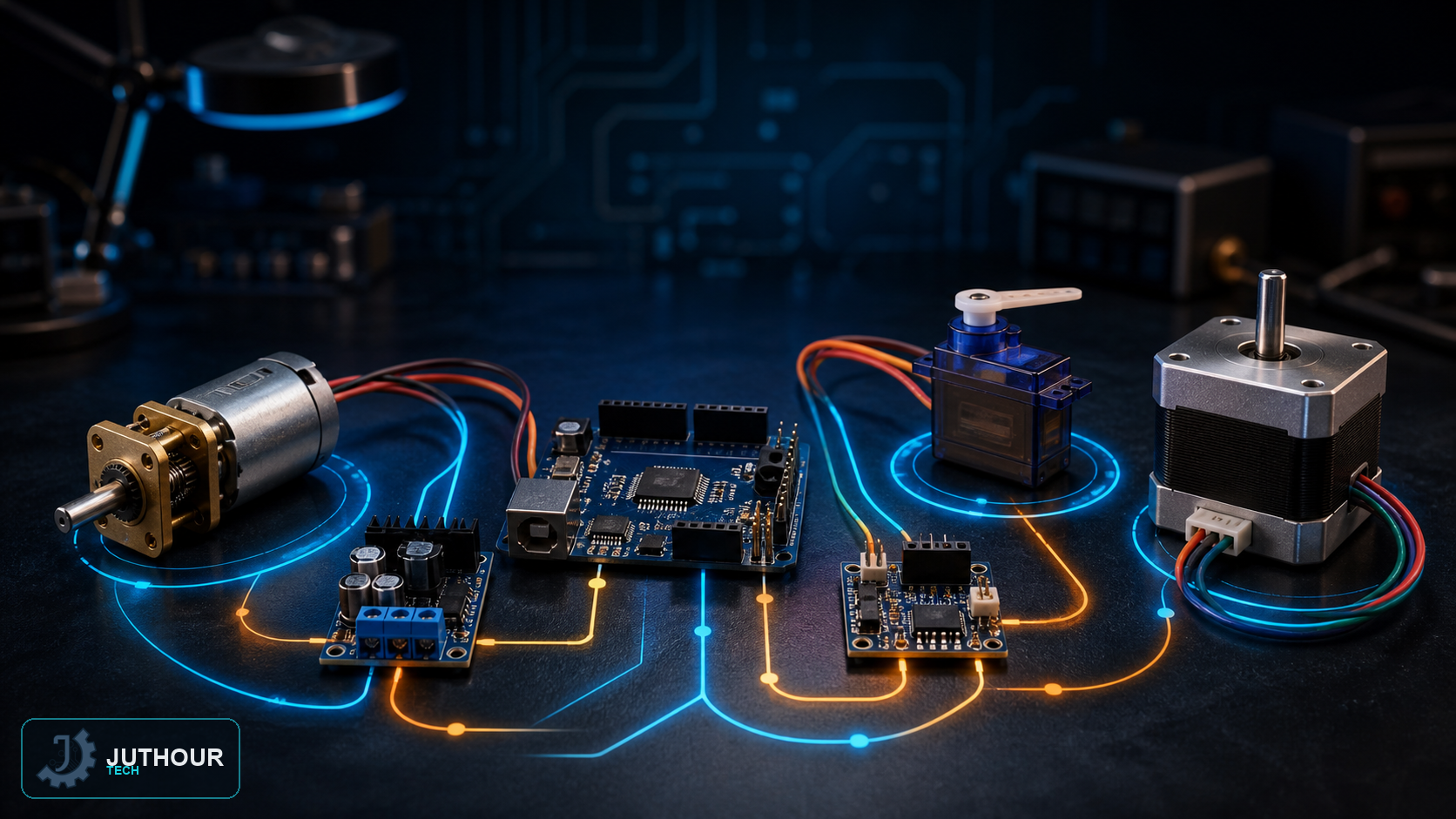
Choosing the right motor type for an Arduino project depends on the kind of motion required: continuous high-speed rotation, precise angular positioning, or finely calculated steps. Three motor types cover most of these needs.
DC Motor
The simplest of the three types, consisting of just two wires, and it spins continuously as long as voltage is applied, with no defined stopping position. Its speed is usually controlled via pulse-width modulation (PWM), making it the best fit for applications needing high rotational speed without a precise position, such as cooling fans and robot wheels.
Servo Motor
Combines a DC motor, a control circuit, a gear train, and a position sensor (potentiometer) into one unit, allowing precise positioning within a limited angular range (typically 180 degrees) via just three wires: power, ground, and control. This makes it ideal for applications needing exact angular position, such as robotic arms and model boat rudders.
Stepper Motor
Made of magnetic coils arranged in a specific pattern, sequentially activated by an external control circuit to produce discrete angular steps (1.8 degrees per step in the common model) across a full 360-degree rotation. The lack of a position sensor is compensated for by precise control over the step count itself, making it the preferred choice for applications needing repeatable precise positioning without a feedback system, such as 3D printers and industrial equipment.
How to choose between them
The choice depends on the project's priorities: speed and low cost point toward a DC motor, simple angular precision points toward a servo, and repeatable high-precision positioning points toward a stepper motor, while also weighing the torque and acceleration each case requires.
You can find all three motor types in various sizes at Juthour Tech.
اترك تعليقا