
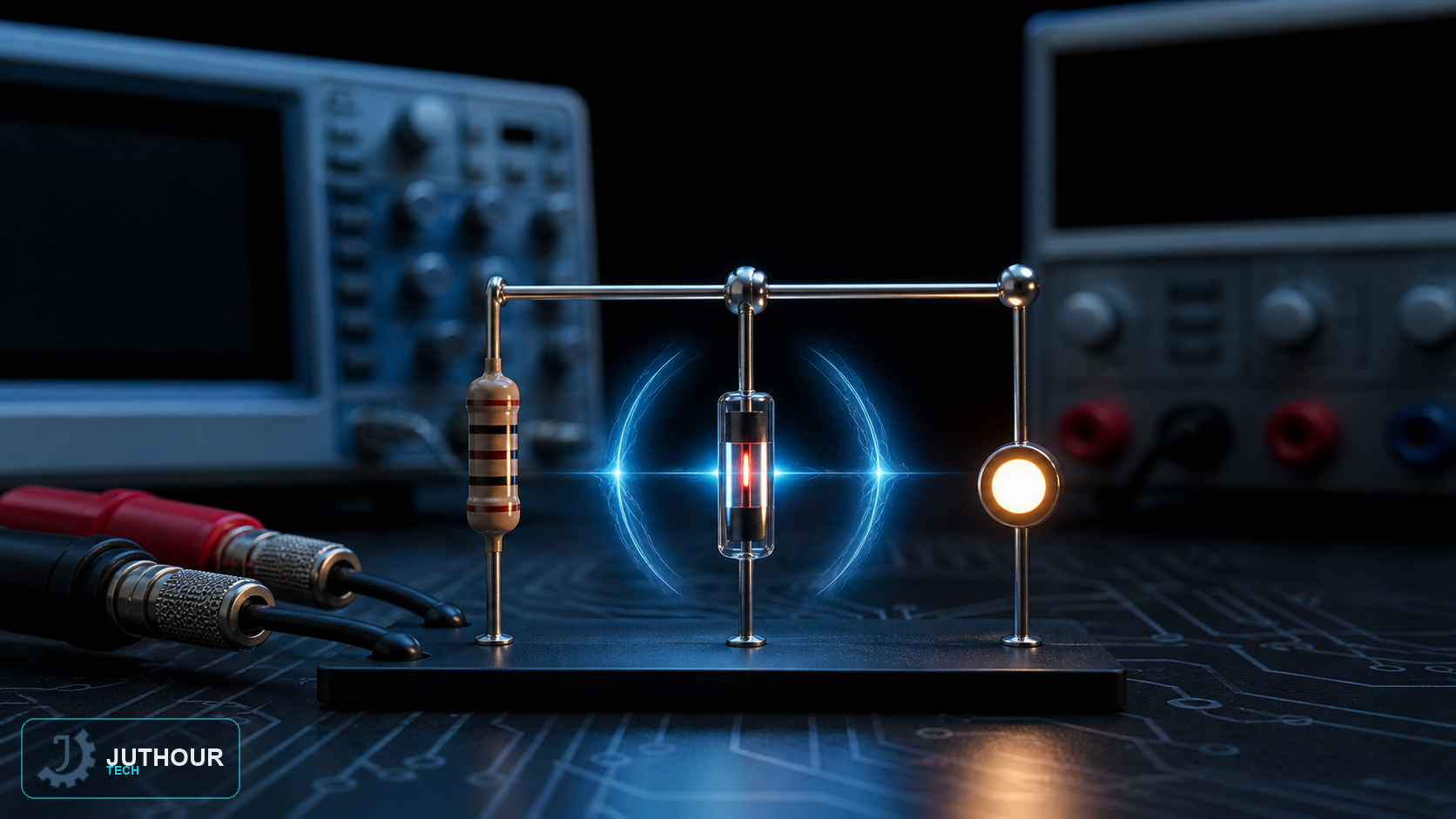
A Zener diode is a special type of diode, deliberately designed to operate in the reverse breakdown region without being damaged — unlike ordinary diodes, which are designed to avoid that region entirely.
How it works
The Zener diode operates through reverse biasing: when the applied reverse voltage exceeds the component's rated Zener voltage (VZ), the diode enters breakdown and allows a relatively large reverse current to flow, while the voltage across it stays nearly constant regardless of how much the current through it changes, within safe limits.
The voltage-stabilizing property
This property — constant voltage despite changing current — is what sets the Zener apart from other diodes, making it a core element in voltage regulation circuits that keep a load's voltage nearly constant despite fluctuations in the source voltage.
Practical uses
Besides voltage regulation, Zener diodes are used in wave-shaping circuits, producing non-standard voltage values not easily available from ready-made sources, and protecting sensitive components like relays from sudden voltage spikes by safely absorbing the excess voltage.
Why it's worth knowing
The Zener's core advantage is its ability to hold a predictable voltage level across a wide range of operating currents within safe limits, making it one of the simplest and most reliable solutions for voltage regulation in small circuits.
You can find Zener diodes in various voltage ratings at Juthour Tech.
اترك تعليقا