
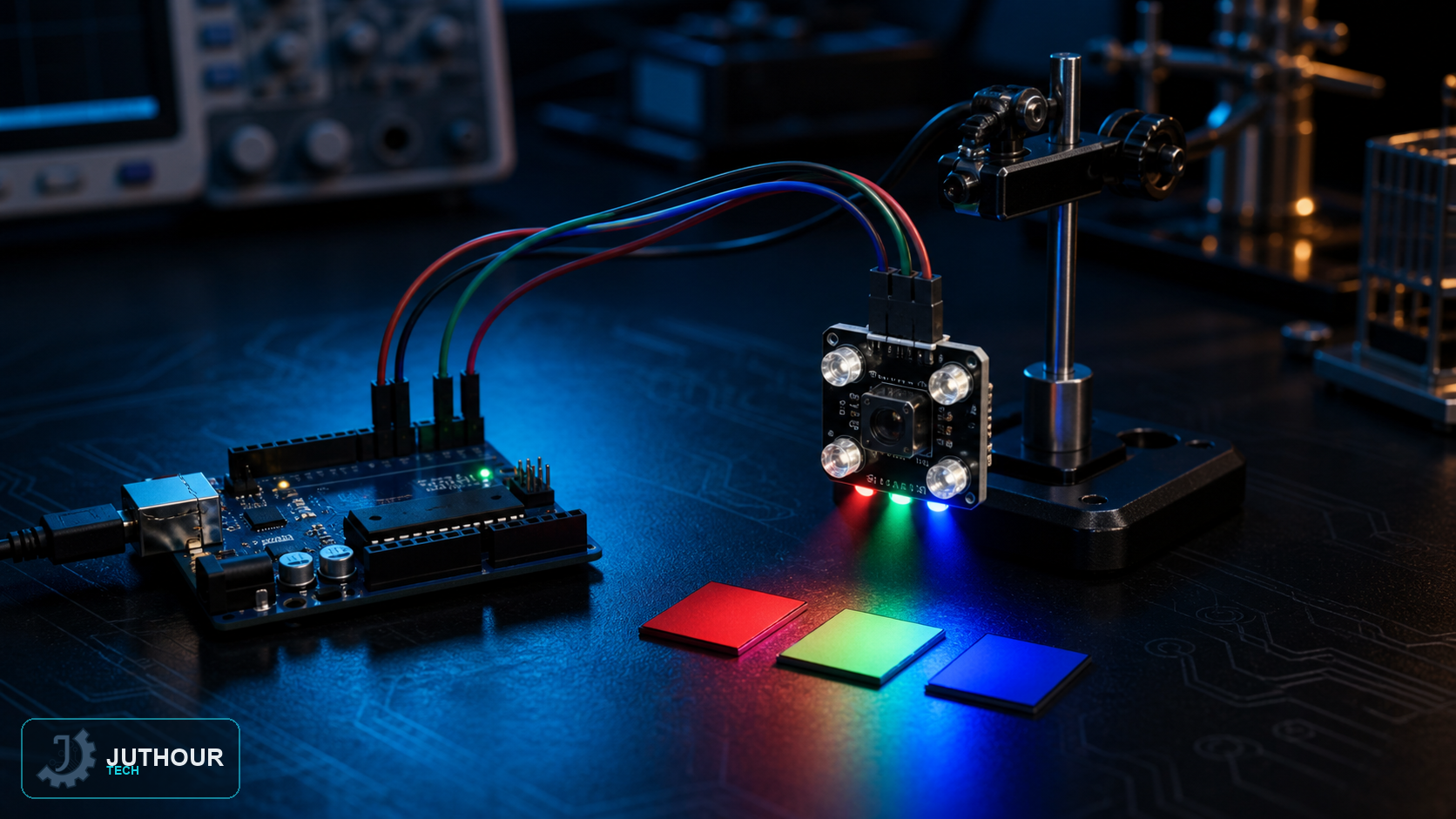
The TCS3200 color sensor (also known as the TCS230) lets Arduino "see" the color of any nearby object and tell it apart from other colors, by measuring the intensity of light reflected off the object after illuminating it with four built-in white LEDs.
Components needed
An Arduino Uno board, a TCS3200 color sensor module, three LEDs (red, green, and blue) to display the result, and connecting wires.
Wiring it up
The sensor's output pin (OUT) connects to digital pin 2, while the control pins S0 through S3 connect to digital pins 3 through 6 respectively, and the three display LEDs connect to pins 8, 9, and 10 for red, green, and blue respectively.
How it works
The sensor contains an internal array of photodiodes covered with color filters (red, green, blue, and clear), and the S0-S3 pins control which group of photodiodes is read and the output frequency scaling. The sensor produces a square wave whose frequency is directly proportional to the intensity of reflected light within each color channel; the more red light reflected, for example, the higher the reading frequency when the red filter is selected. The code measures the frequencies of the three channels in sequence, compares them against each other to determine the dominant color, then lights the matching LED as visual confirmation.
You can find the TCS3200 color sensor module at Juthour Tech.
اترك تعليقا