
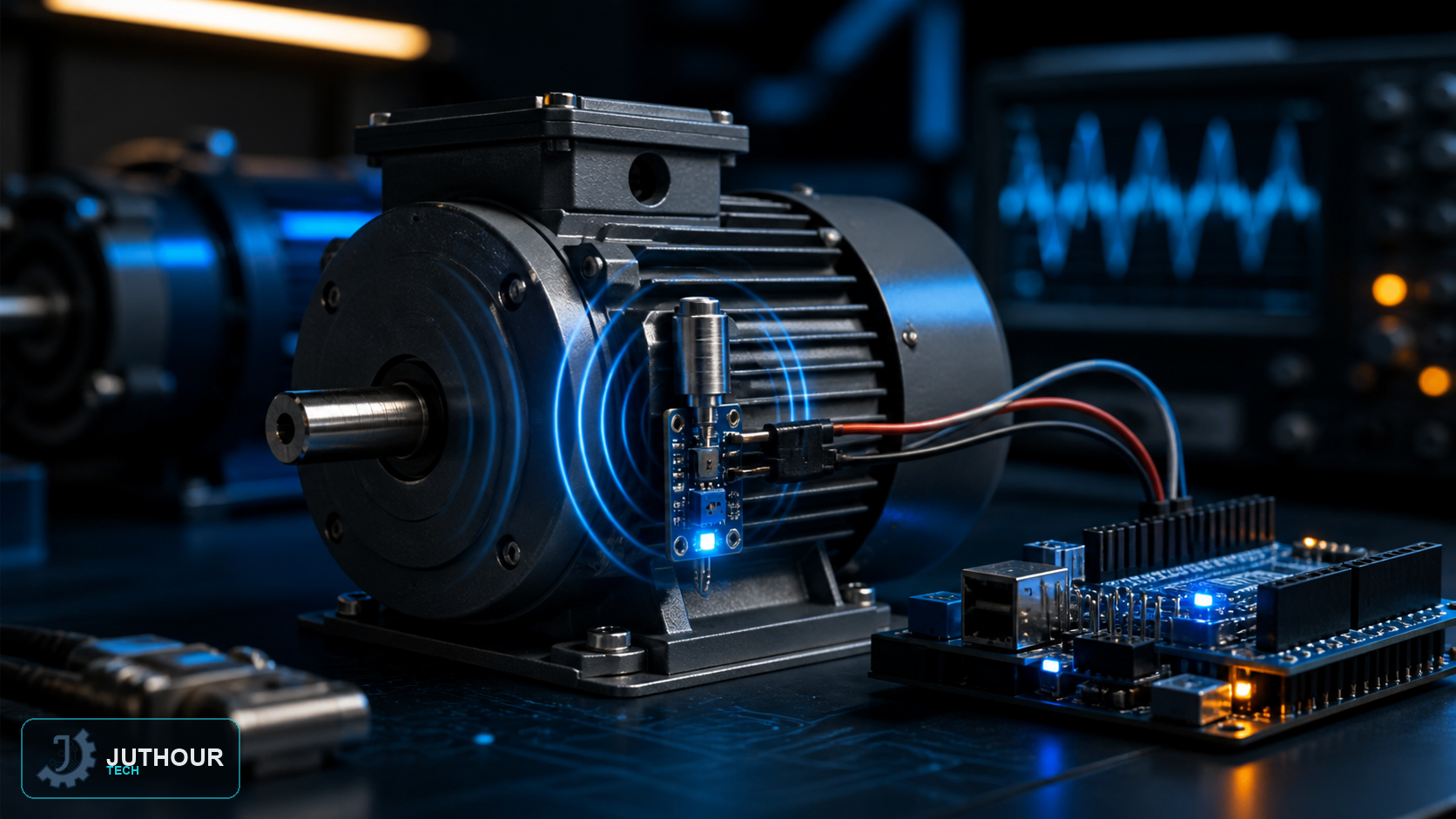
The SW-420 vibration sensor lets you detect any abnormal vibration or mechanical shock, making it an economical alternative to expensive industrial accelerometers for simple monitoring applications on sensitive machinery and equipment.
Components needed
An Arduino Uno board, an SW-420 vibration sensor module, an LED, and connecting wires.
Wiring it up
The module's digital output connects to analog pin A5 (used here as a digital pin), and the indicator LED connects to digital pin 13.
How it works
Internally, the module relies on an LM393 comparator and a vibration-sensitive mechanical switch, with an on-board potentiometer to set the sensitivity threshold and tell real vibrations apart from normal ambient noise. The code relies on state-change detection: it compares the current sensor reading against the previous one on every loop, and upon detecting any transition between them (signaling a momentary vibration), it runs a blink sequence of four pulses, each lasting 250 milliseconds, while the LED stays completely off when things are stable with no vibration.
Practical applications
This sensor suits economical monitoring systems for sensitive machinery that could be damaged by abnormal vibration, providing early warning at a fraction of the cost of specialized industrial accelerometers.
You can find the SW-420 vibration sensor at Juthour Tech.
اترك تعليقا