
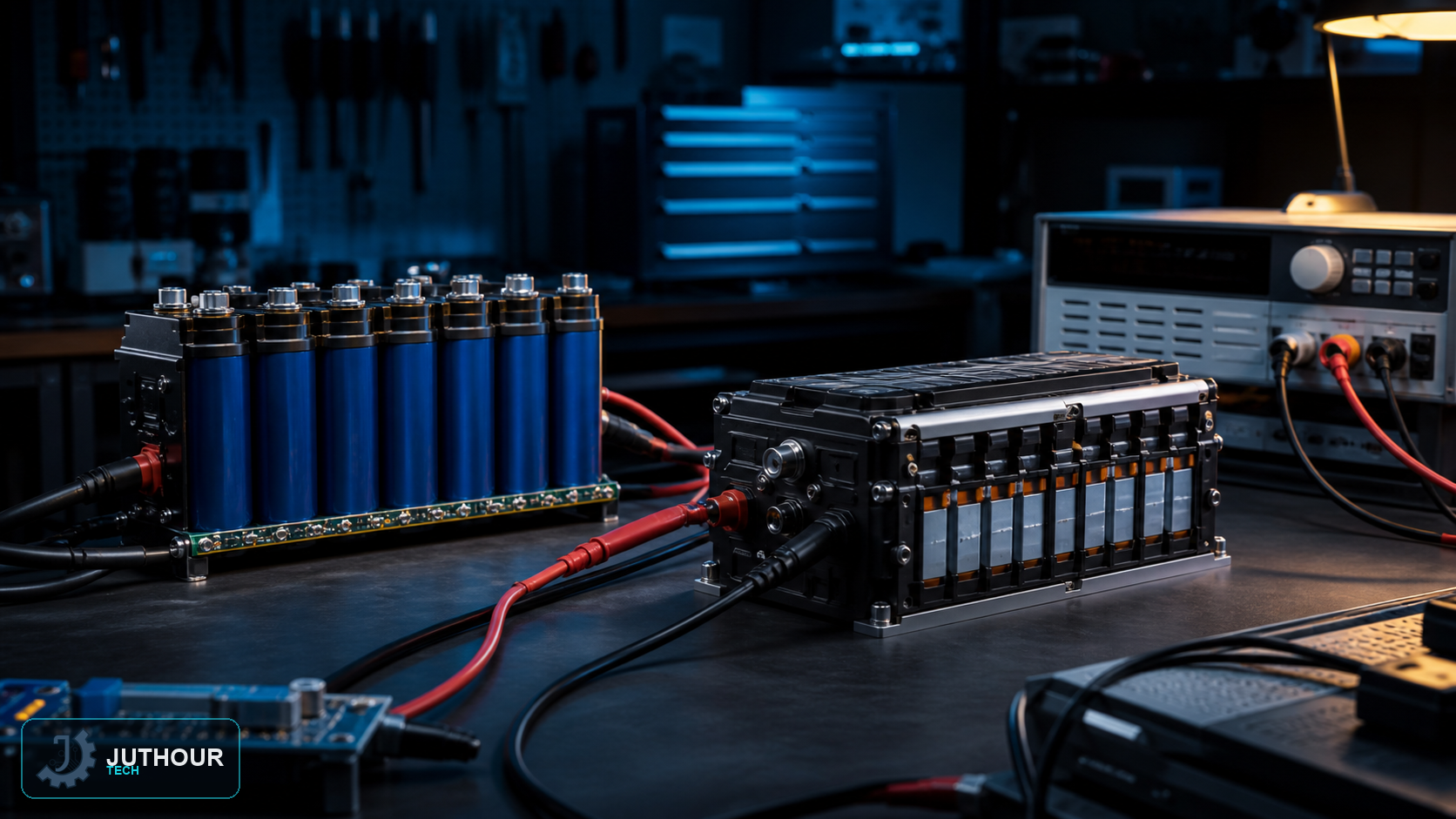
Batteries and supercapacitors store energy through different mechanisms, so neither should be selected from capacitance or voltage alone. Runtime, peak current, cycle count, and system volume are the useful design inputs.
Energy versus power
Batteries normally store far more energy per kilogram and suit hours of operation. Supercapacitors can deliver high peak power and charge quickly, but hold much less energy for their size and generally have higher self-discharge.
Cell voltage and series strings
Many commercial supercapacitor cells are rated around 2.7 to 3 V. A 5.5 V module normally contains series-connected cells, and a series string needs balancing and monitoring so no cell exceeds its limit.
Life and efficiency
Supercapacitors may tolerate hundreds of thousands of cycles, but life and efficiency depend on product series, voltage, current, and temperature. Battery behavior varies strongly with chemistry and the battery-management system, so a single universal percentage is misleading.
Making the choice
Use a battery for sustained energy, a supercapacitor for peak power or short ride-through, or combine them in a hybrid system. Check the selected datasheet and calculate usable energy, ESR, thermal limits, balancing, and protection.
اترك تعليقا