
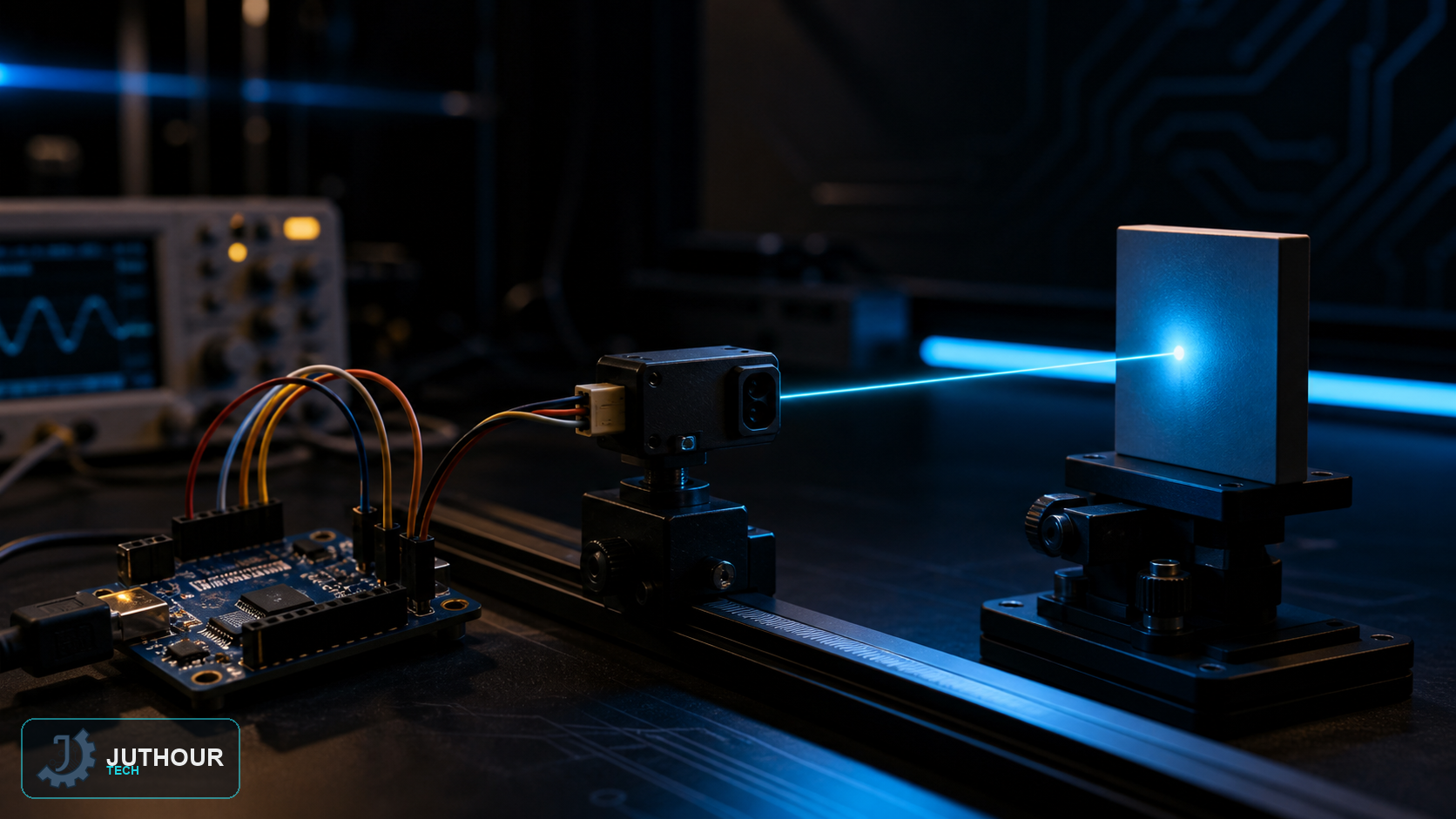
Sharp infrared distance sensors are a good alternative to ultrasonic sensors in some applications, since they rely on optical triangulation rather than sound echo timing, and provide an analog output proportional to distance.
Components needed
An Arduino Uno board, a Sharp distance sensor (such as the GP2Y0A02YK model), an LED, and connecting wires.
Wiring it up
The sensor has three pins: 5V power, ground, and an analog output that connects to pin A0. The LED connects to digital pin 11, which supports PWM output, and it's best to add a 220-ohm resistor to protect it, though some basic examples skip it with low-power LEDs.
How it works
The closer an object gets to the sensor, the higher the analog voltage on its output, and vice versa as it moves away. In the basic example, the code reads the value via analogRead(A0) and directly converts it into a brightness level for the LED via analogWrite(LED, val/4), dividing the analog reading (which ranges from 0 to 1023) by 4 to fit PWM's limited 0-255 range. To convert this value into an actual distance in centimeters, you need to consult the calibration curve in the datasheet for the specific model used, since the relationship between voltage and distance is not linear.
You can find Sharp distance sensors at Juthour Tech.
اترك تعليقا