
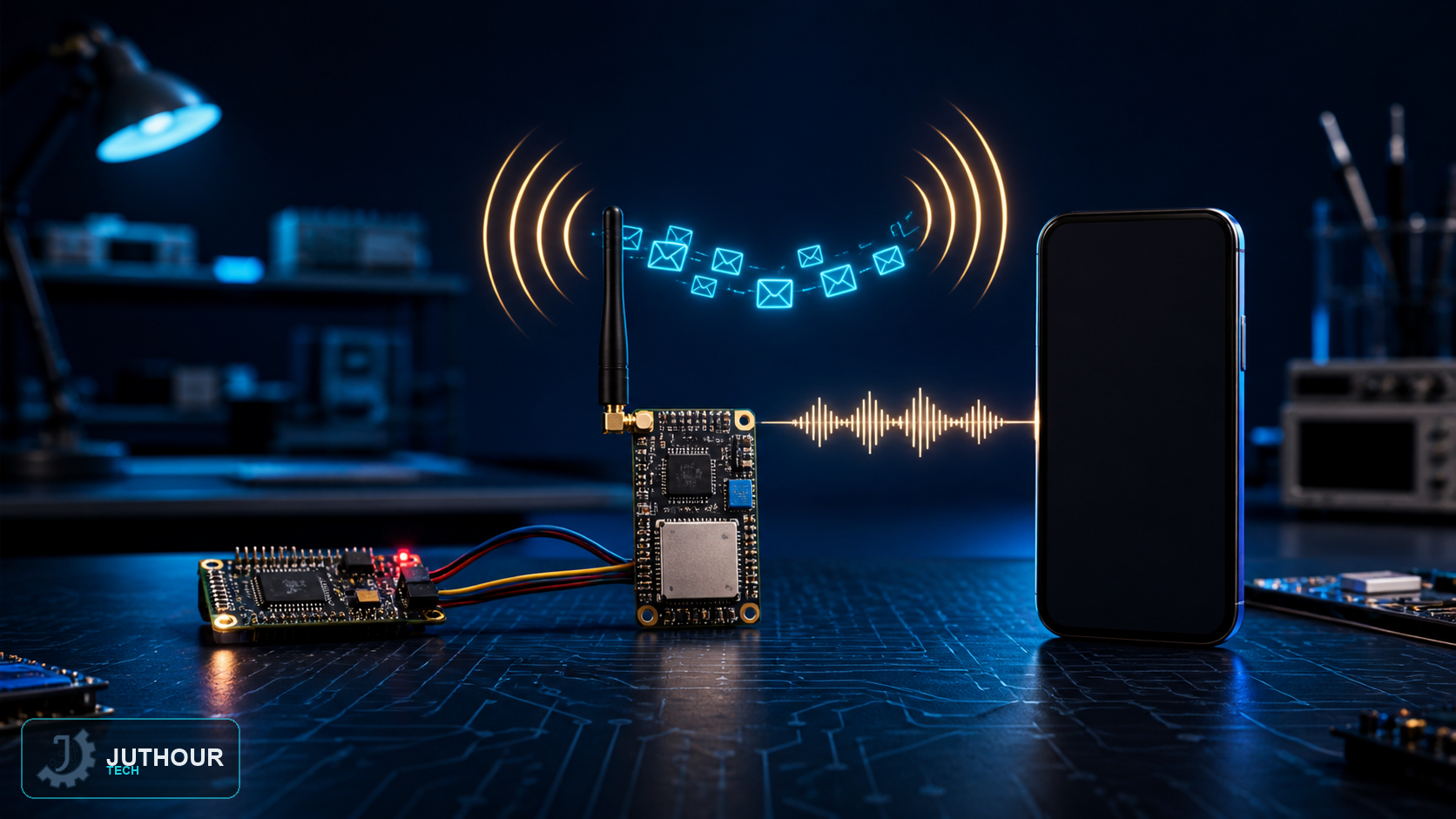
After covering the SIM800L module's components and power requirements in part one, this part covers the practical implementation: sending and receiving text messages, and making and receiving calls, using standard AT commands.
The voltage gap between the module and Arduino
The SIM800L runs on 3.3V logic while most Arduino boards run on 5V logic, so the module's RxD data pin needs protection from the higher voltage coming out of the Arduino's TxD.
Sending and receiving text messages
The code sets the module to TEXT mode via a dedicated AT command, then sends the message with the recipient's number through a sequence of commands. Receiving incoming messages works by enabling an automatic notification that appears on the serial port as soon as a new message arrives, which the code reads and processes.
Making and receiving calls
The code can start an outbound call for a set duration and then end it automatically, and it can also recognize incoming calls via the "RING" response the module sends, accepting or rejecting them programmatically using standard AT commands.
Code implementation
All the examples rely on the SoftwareSerial library at 9600 baud to talk to the module, starting with testing basic AT commands, through sending and receiving messages and parsing their content, up to starting and receiving calls — opening the door to applications like remote alarm systems, monitoring, and triggering actions via text message.
You can find the SIM800L module and voltage-divider components at Juthour Tech.
اترك تعليقا