
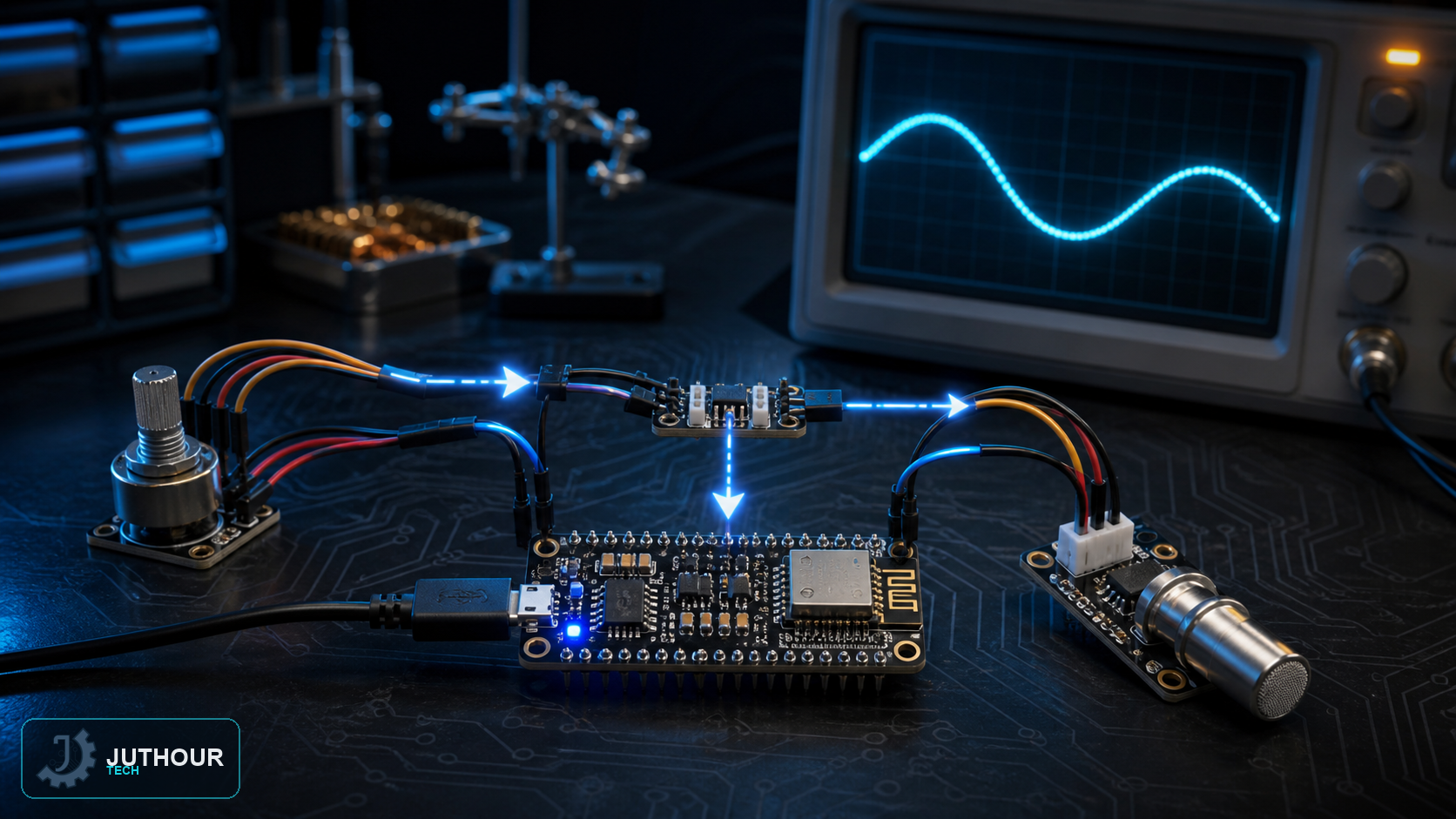
The ESP8266's analog-to-digital converter (ADC) differs from a traditional Arduino's in two key ways worth knowing before starting any analog sensor project.
Resolution and voltage range
The ESP8266 offers a 10-bit converter, giving values between 0 and 1024. But the accepted voltage range varies by board form factor: development boards like the NodeMCU accept 0 to 3.3V directly, while the bare chip accepts no more than 1V, requiring a voltage-divider circuit to protect it when working with it directly.
Just one pin
Unlike traditional Arduino boards that offer several analog pins, the ESP8266 provides only a single ADC pin, usually labeled A0, TOUT, or Pin6 — a fundamental constraint that requires careful circuit planning when a project needs more than one analog reading.
Programming it
Reading analog values follows the usual Arduino pattern: the analogRead(A0) function captures the sensor value, which can then be converted to a different range via the map() function as the project needs. It's recommended to set serial communication to 115200 baud to monitor the reading's changes in real time via the Serial Monitor.
You can find ESP8266 and NodeMCU boards at Juthour Tech.
اترك تعليقا