
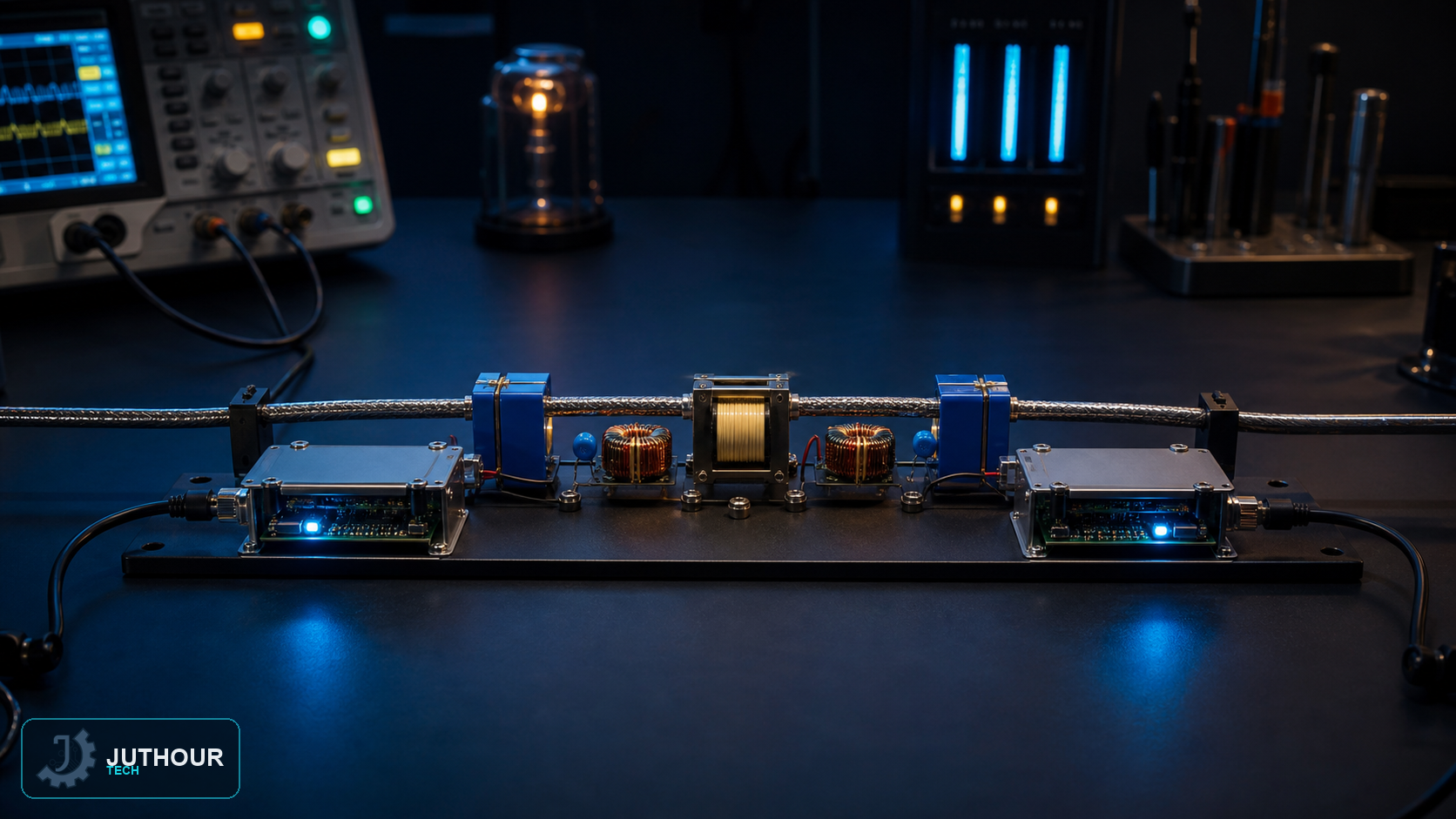
Power Line Communication (PLC) takes the electrical wiring already running through a building or across a utility grid and uses it to carry data as well as electricity — no separate cabling needed.
How it works
A purpose-designed coupling and filtering network superimposes a higher-frequency data signal on the power conductors, while the receiver separates it from the low-frequency power waveform. The data does not pass through an ordinary rectifier or relay. Power Line Communication should also be distinguished from a Programmable Logic Controller, which shares the PLC abbreviation.
The four main categories
PLC systems are generally grouped into four types: indoor broadband over a building's own household wiring, broadband access delivered over the utility's external power lines, low-bandwidth indoor use for home-automation signaling, and low-bandwidth outdoor use for things like automated meter reading and remote monitoring.
Where it gets used
Beyond internet and audio/video distribution, PLC shows up in broadcasting distribution networks, automated switching for utility equipment, protection systems for transmission lines, remote electricity-meter reading, and even vehicle communication systems that run signals over a vehicle's own DC battery wiring with specialized filtering.
Strengths and trade-offs
Reusing existing wiring is attractive, but performance depends on network topology, noise, connected loads, transformers, and filters. A design should therefore be tested on the real electrical network and the PLC technology selected for the required range, data rate, and reliability.
You can find home-automation and networking modules at Juthour Tech.
اترك تعليقا