
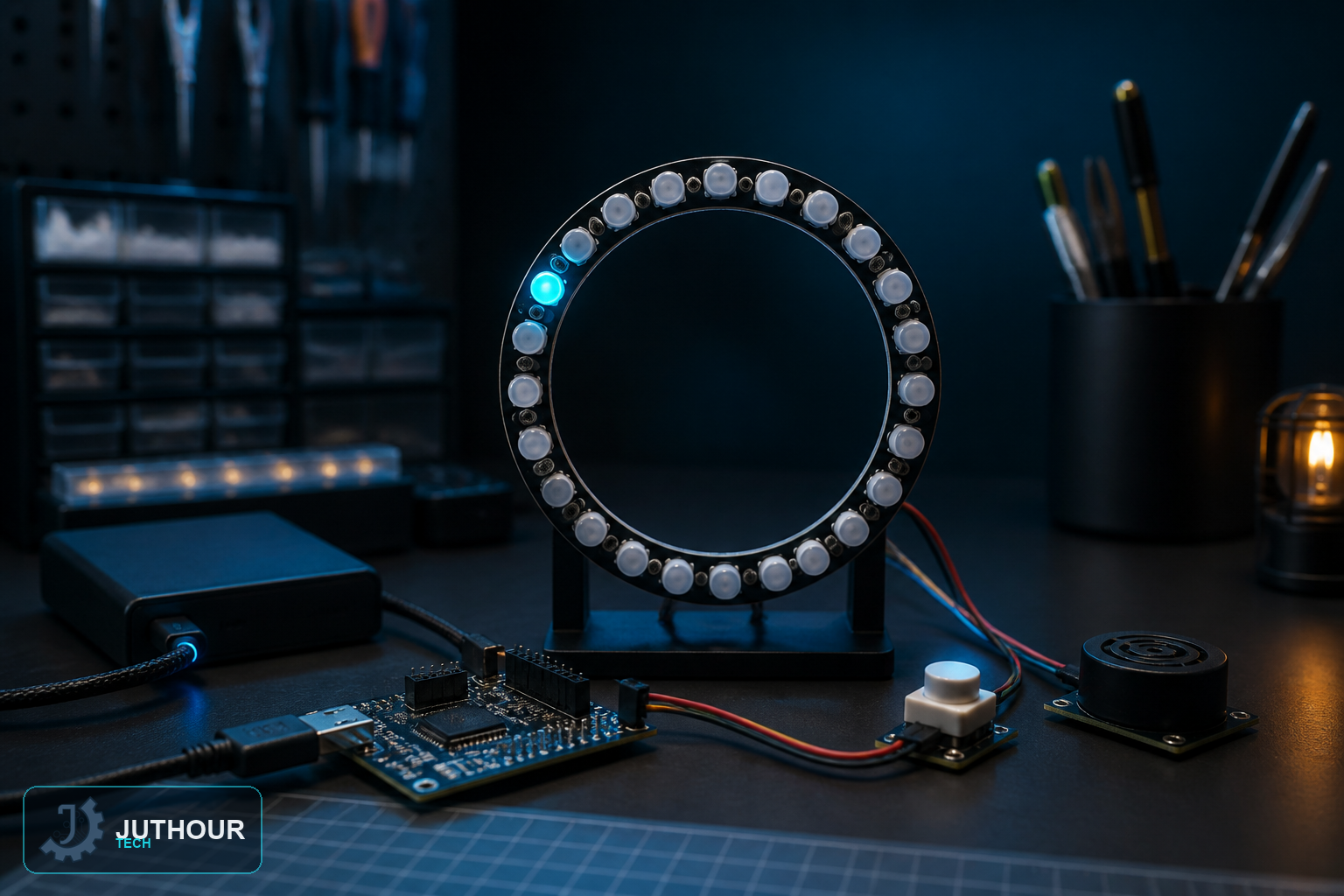
Mini Cyclone is a classic arcade reflex challenge: a point of light races around a ring, and you have to press a button at exactly the right instant to stop it on the target — simple to understand, surprisingly hard to master as the margin for error shrinks.
Components needed
An Arduino Nano, a 16-LED WS2812 ring, a 16x2 I2C LCD, two push buttons (one for play, one to reset the high score), a buzzer, and a breadboard.
Wiring it up
The WS2812 ring connects to pin 2 for its single-wire data line, the play button to pin 6, and the LCD over standard I2C on A4/A5. The reset button ties to Arduino's own reset pin, and the buzzer connects to pin 10.
How the gameplay works
A single lit LED continuously travels around the ring. Pressing the play button freezes it in place — landing on or within the target zone counts as a hit, scored and shown on the LCD along with the current round. Early rounds are forgiving, with a three-LED-wide safe zone around the target; as rounds progress, that margin shrinks down to the single target LED itself, testing reaction timing much more precisely.
Keeping score
The buzzer gives audio feedback on hits and misses, and the game saves the high score to Arduino's persistent memory, so it survives being powered off and on again rather than resetting every time.
How this compares to our LED strip racing game
Both this project and our LED strip racing game use WS2812 addressable LEDs for the visual gameplay, but they're built around very different mechanics: Mini Cyclone is a single-player precision-timing challenge on a small circular ring, while the racing game is a competitive two-player button-mashing race down a long strip — worth building both if you're interested in WS2812-based games generally, since each shows a distinct way to use the same underlying LED technology.
You can find WS2812 LED rings at Juthour Tech.
اترك تعليقا