
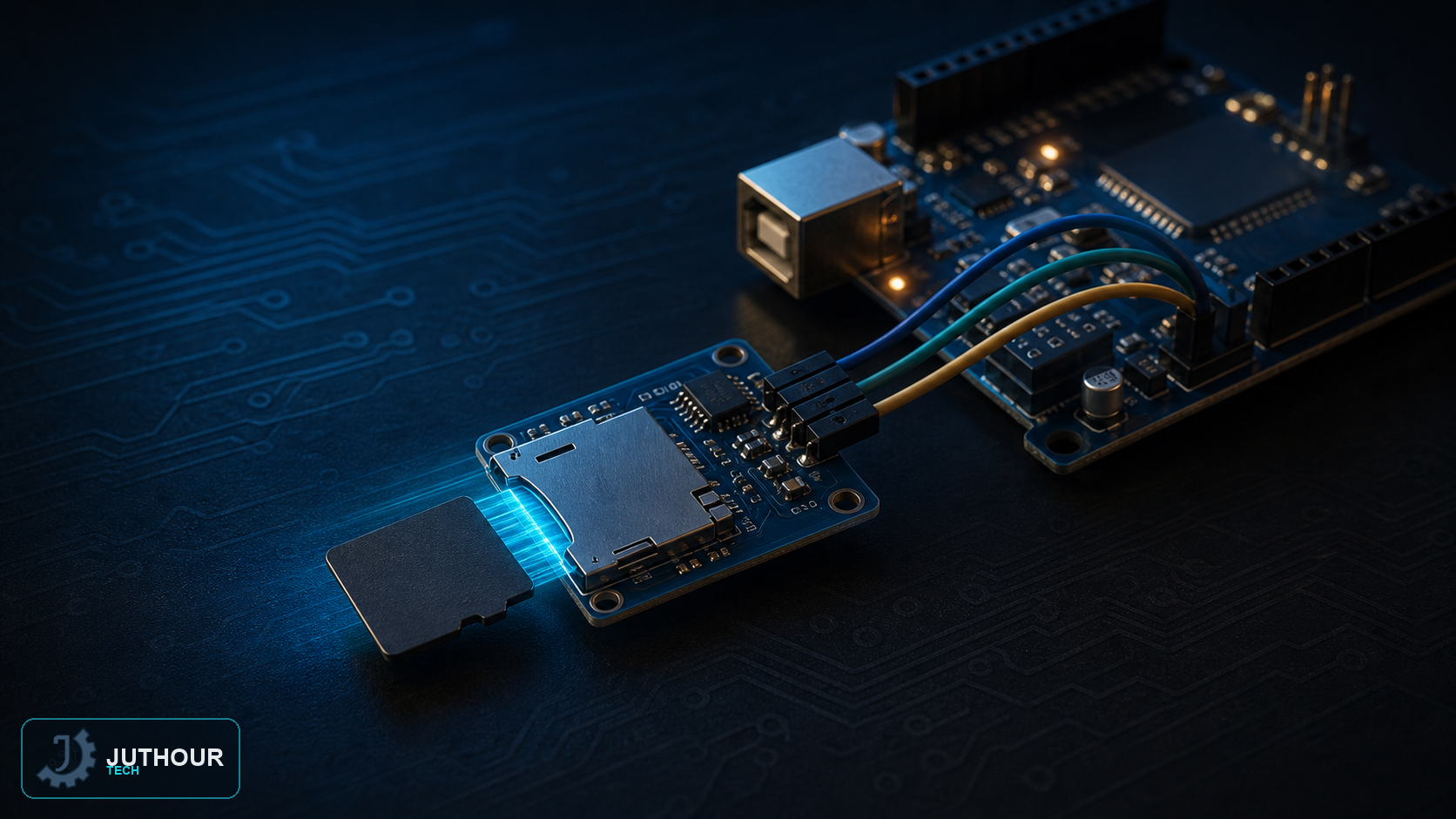
A Micro SD card reader module turns any Arduino project into a system capable of storing large amounts of data, instead of being limited to the board's small internal memory.
What this module is
It's a small board carrying a Micro SD card slot, with a built-in voltage-conversion circuit that lets it connect to 5V-logic Arduino boards, even though SD cards themselves run on 3.3V logic only. The module communicates with the controller via the high-speed SPI protocol, the same protocol used by TFT displays and other memory chips.
Pin count and wiring
The module typically needs six pins: power (VCC, usually 5V) and ground (GND), plus four SPI pins: MOSI to send data to the card, MISO to receive data from it, SCK for the clock signal, and CS (chip select), which determines when the module is active on the SPI bus — the only pin that can move to any free digital pin, while the other three stay tied to the Arduino board's fixed SPI pins (11, 12, and 13 on the Uno).
Programming it
The standard SD library bundled with Arduino IDE manages reading and writing on a FAT16 or FAT32 filesystem, via familiar functions like SD.begin() to initialize the connection, SD.open() to open a file, and the usual read/write functions similar to handling files in any general-purpose programming language. This simplicity makes the module the foundation of any project needing long-term data logging, from weather stations to standalone monitoring systems.
You can find Micro SD card reader modules at Juthour Tech.
اترك تعليقا