
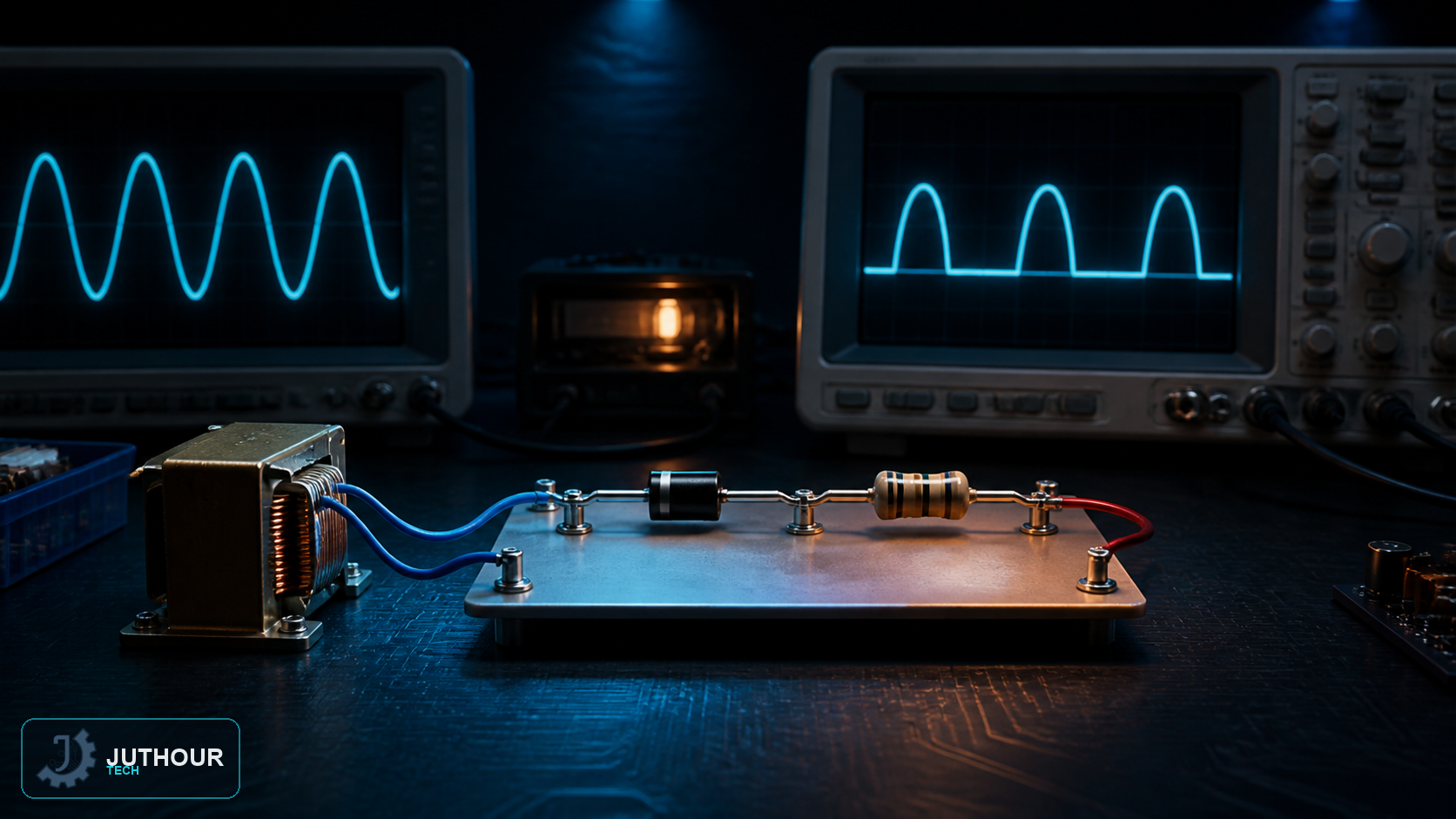
A half-wave rectifier is the simplest circuit for converting alternating current (AC) into direct current (DC), relying on a single physical principle: letting current flow in only one direction.
The core component: the diode
A single diode does all the work in this circuit, exploiting its fundamental property — conducting electricity only from anode to cathode — which makes it ideal for this task.
How the circuit works
During the positive half of the AC cycle, the diode is forward-biased and acts as a closed switch, letting the positive voltage pass through to the load resistor. During the negative half, the diode is reverse-biased and acts as an open switch, blocking any voltage from reaching the load.
Output characteristics
This selective conduction produces a pulsating DC voltage containing only the positive halves of the wave, with an effective value of about 31.8% of the input peak voltage — but it remains an unfiltered, highly variable output, far from the stable, constant voltage electronic circuits need.
An efficiency limitation
The main drawback of this circuit is wasted power: no output appears during the negative half of the cycle, meaning roughly half the available power goes unused — which explains this design's lower efficiency compared to full-wave rectifiers.
You can find diodes and basic electronic circuit components at Juthour Tech.
اترك تعليقا