
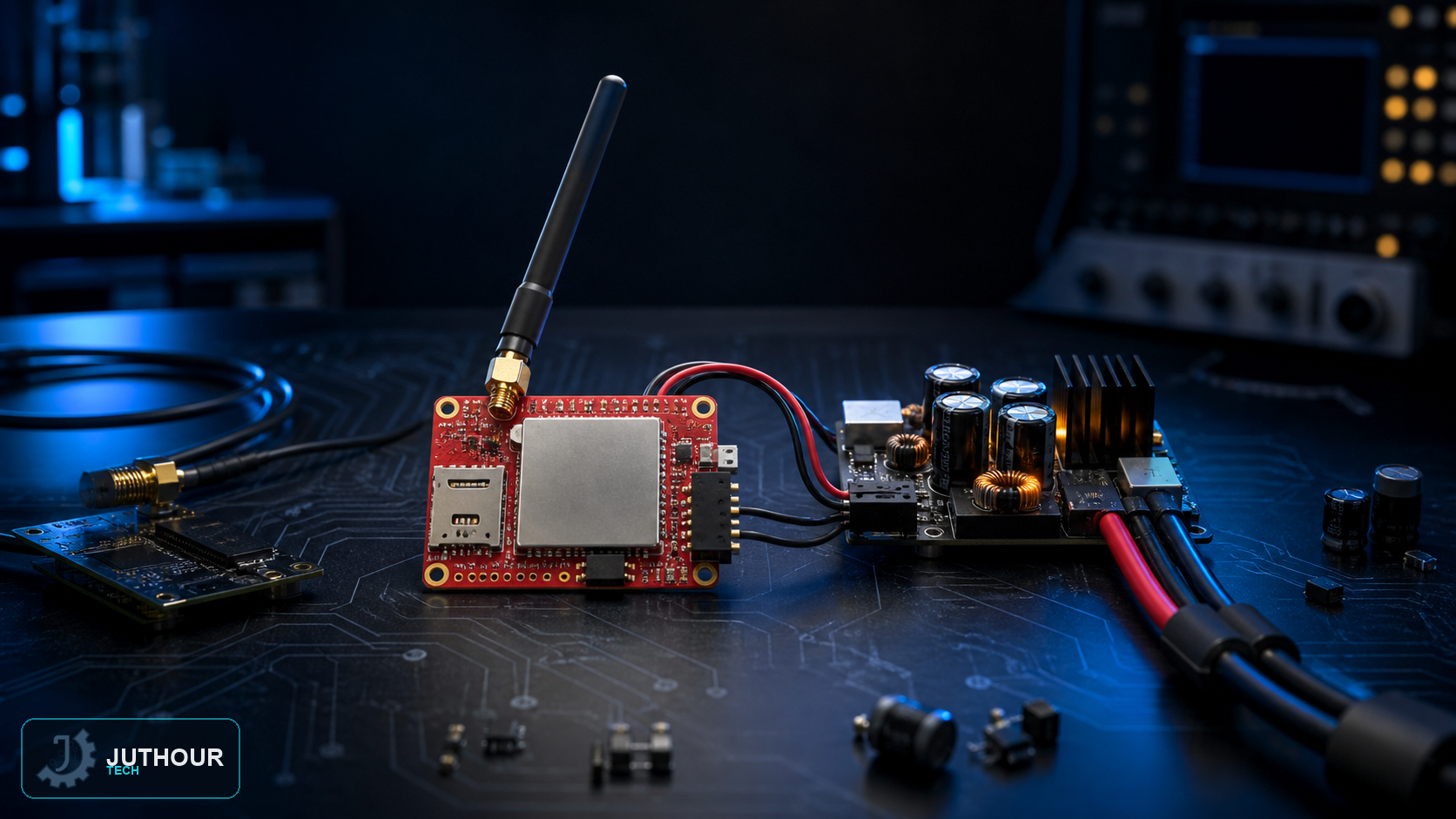
The SIM800L module lets an Arduino project talk directly to the cellular network, sending and receiving text messages and making calls without needing the internet or an intermediary phone. This first part covers the foundational aspects — components, power, and pinout — while part two covers the practical implementation of sending/receiving messages and calls.
Module components
The module includes a nano-SIM card slot, an LED status indicator, and two antenna options: a built-in helical antenna or an external U.FL connector for better reception in weak-coverage areas.
Power requirements
The module operates on a relatively narrow 3.4 to 4.4V range, but can draw up to 2A during transmission — a current far beyond what most Arduino boards' onboard voltage regulators can supply.
Pinout
The module offers 12 pins covering power and ground (VCC/GND), serial communication (RxD/TxD), a reset pin, and audio pins for a microphone and speaker that let the module act as a full-featured phone when needed.
You can find the SIM800L module and its power supplies at Juthour Tech.
اترك تعليقا