
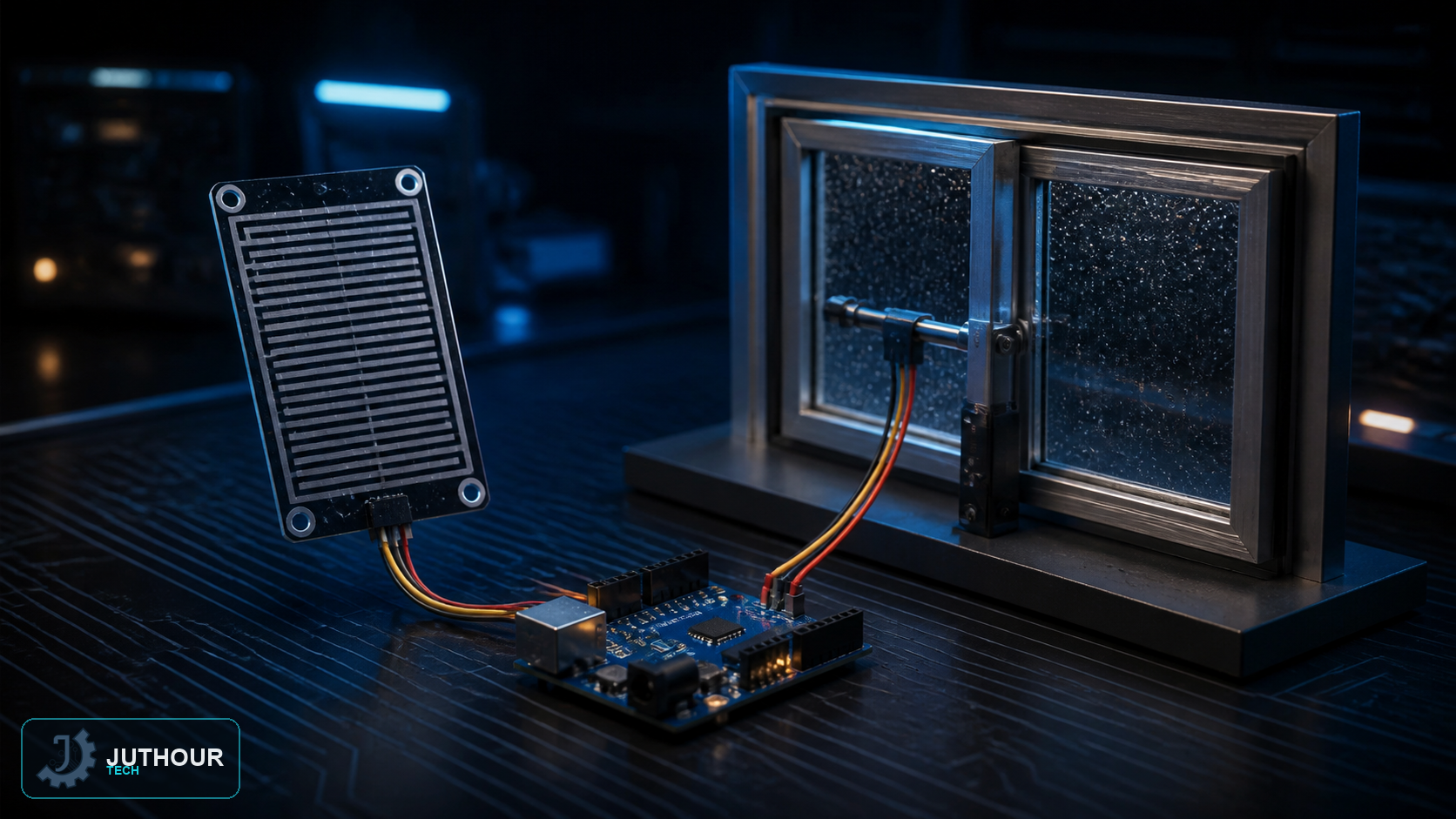
The FC-37 rain sensor lets you detect rainfall automatically, giving you a practical foundation for any smart-home project that needs to react automatically when it rains — such as closing windows or stopping an outdoor irrigation system.
Components needed
An Arduino Uno board, an FC-37 rain sensor module (made up of an outdoor sensing board and an electronic control board with a sensitivity-adjustment potentiometer), a green and a red LED, and connecting wires.
Wiring it up
The control board's analog output connects to pin A0 on the Arduino, and the green and red LEDs each connect to their own digital pin to indicate the dry or wet status.
How it works
The sensing board works on a changing-resistance principle: the more water accumulates on its metal traces, the lower its resistance and the higher the current flow, which is reflected in the voltage value the control board reads. The code compares the analog reading against a threshold of 500: if the value is below this threshold (indicating water present), the red LED lights up and a "It's wet" message is printed; if it's above, the green LED lights up with an "It's dry" message, with this reading repeating every 500 milliseconds.
Extending to real automation
The basic example is limited to showing the result via LEDs and the serial monitor, but this output can easily be replaced with driving a servo motor or a relay to automatically close a window or an awning as soon as rain is detected.
You can find the FC-37 rain sensor module at Juthour Tech.
اترك تعليقا