
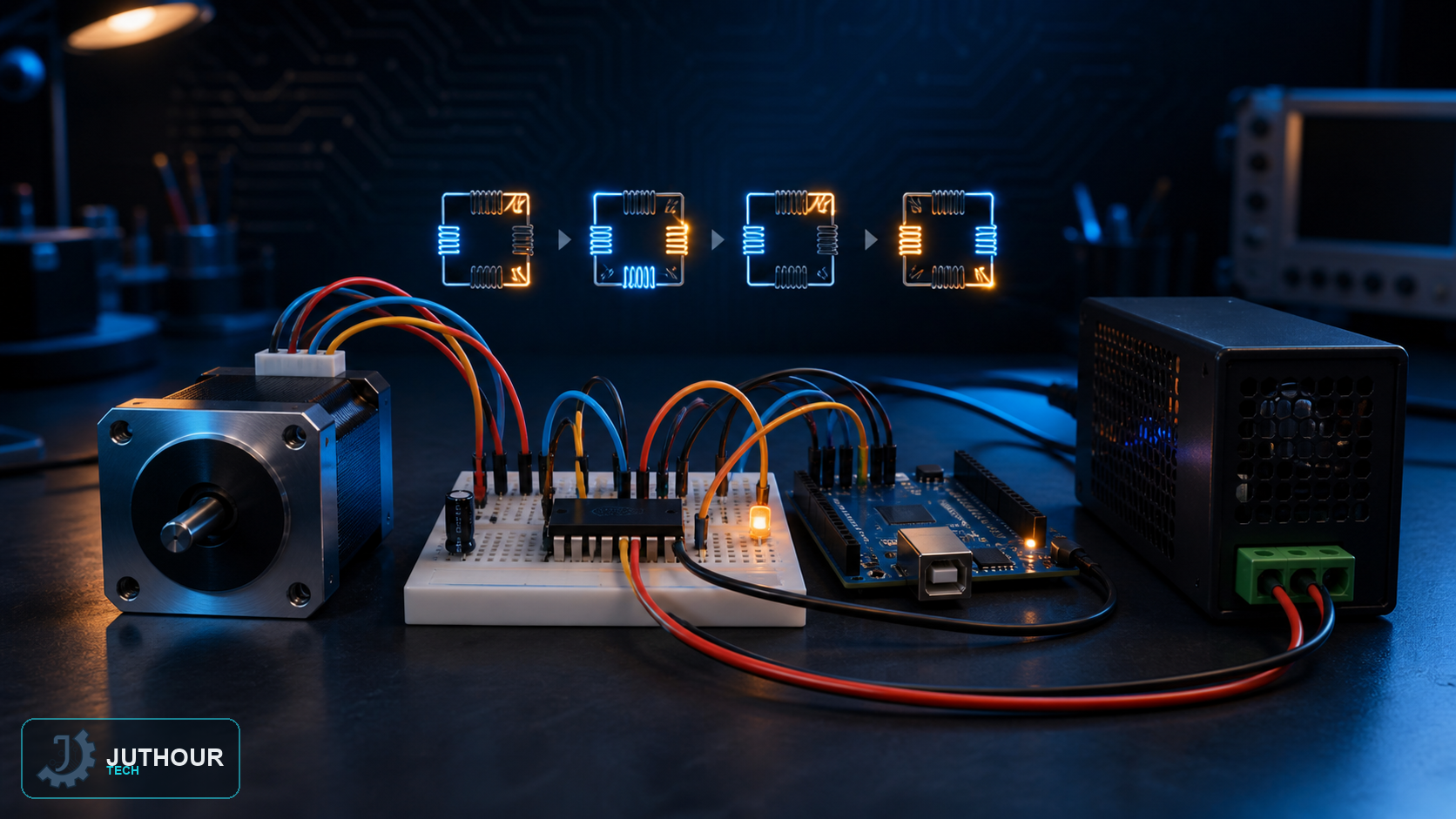
The L293D chip is a dual driver with two full H-bridges, making it a practical choice for controlling a stepper motor by running its two coils independently and in sequence.
Components needed
An Arduino board, an L293D IC, a stepper motor (unipolar like the 28BYJ-48 or bipolar like the NEMA 17), and an external power supply matching the motor's voltage.
Wiring it up
The chip needs two separate power sources: Vcc1 for logic (5V from Arduino), and Vcc2 to power the motor (5 or 12V depending on the type). Four Arduino digital pins (typically 9 through 12) connect to the chip's IN1 through IN4 input pins to sequence the coil activation, while the chip's outputs connect directly to the stepper motor's coil pairs — with a slight difference in which wires are used between unipolar and bipolar motors. The ENA and ENB enable pins must be tied to 5V to keep the chip continuously active.
How it works
The code relies on the Stepper library to automate the coil-activation sequence, with the steps-per-revolution value set to match the motor model: 200 steps for the bipolar NEMA 17, and 48 steps for the unipolar 28BYJ-48. The chip's wide operating voltage range (4.5 to 36V) plus its onboard thermal protection give considerable flexibility in choosing the right motor model for the project.
You can find L293D ICs and stepper motors of various types at Juthour Tech.
اترك تعليقا