
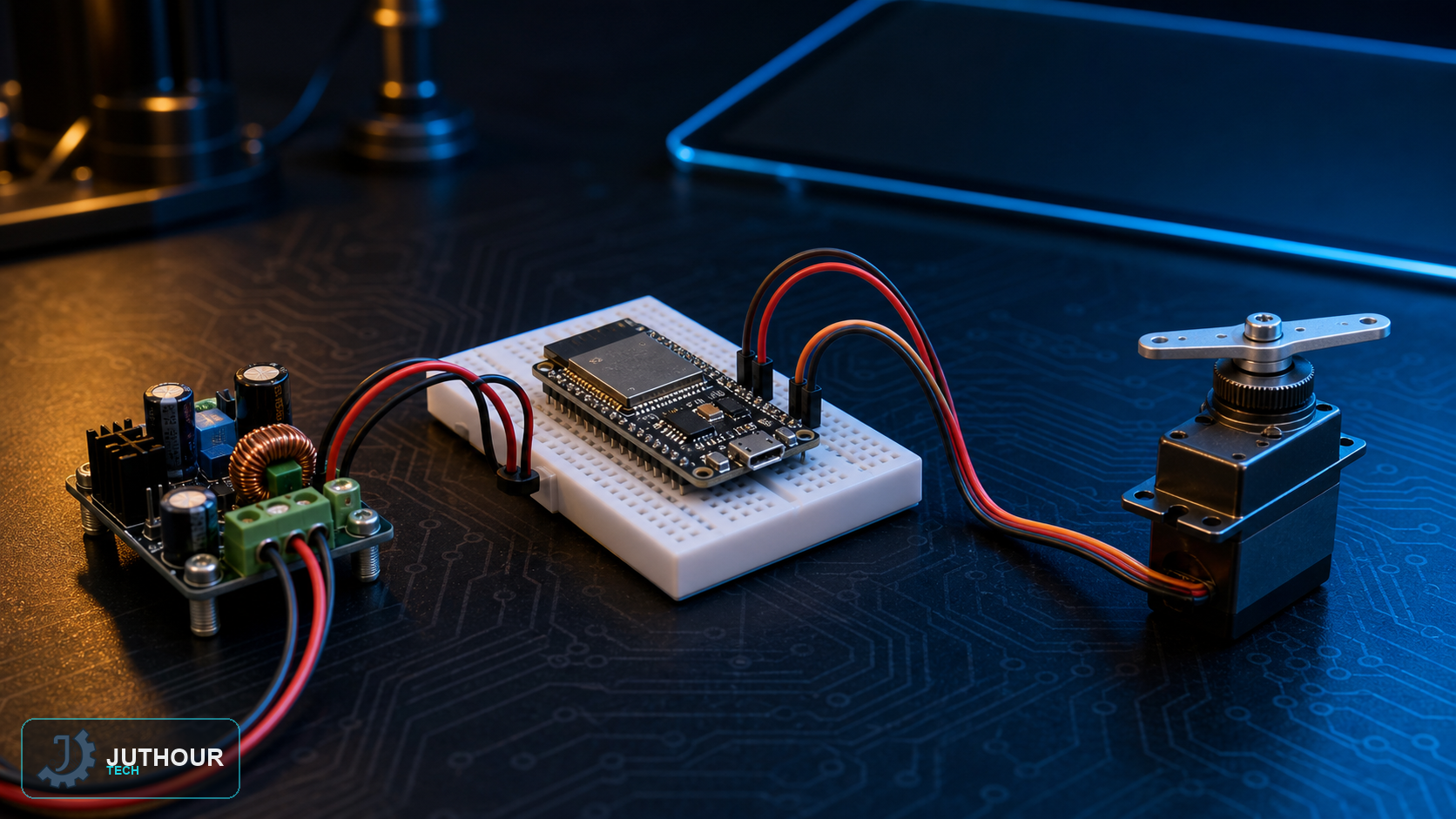
Part 1 establishes reliable ESP32 servo control before adding a web interface. Pulse width determines shaft position, commonly at about 50 Hz for hobby servos, but mechanical range and pulse limits vary by model.
Use a regulated external supply
Even a small servo can draw a large transient or stall current. Use a regulated 5 V supply sized for the specified stall current and connect its ground to ESP32 ground. Do not assume the board's 5 V pin or USB source can power the servo safely.
Select the signal pin
Choose an output-capable GPIO using the pinout for the exact development board. Flash, strapping, and input-only restrictions vary across ESP32 families and boards, so a universal avoid-list is unreliable. GPIO13 is suitable on many original ESP32 boards after verification.
Programming and calibration
ESP32Servo can set frequency and pulse limits. Begin near the centre, then expand travel gradually without driving the linkage into a hard mechanical stop. If the board resets when the servo moves, investigate power and grounding before changing software.
اترك تعليقا