
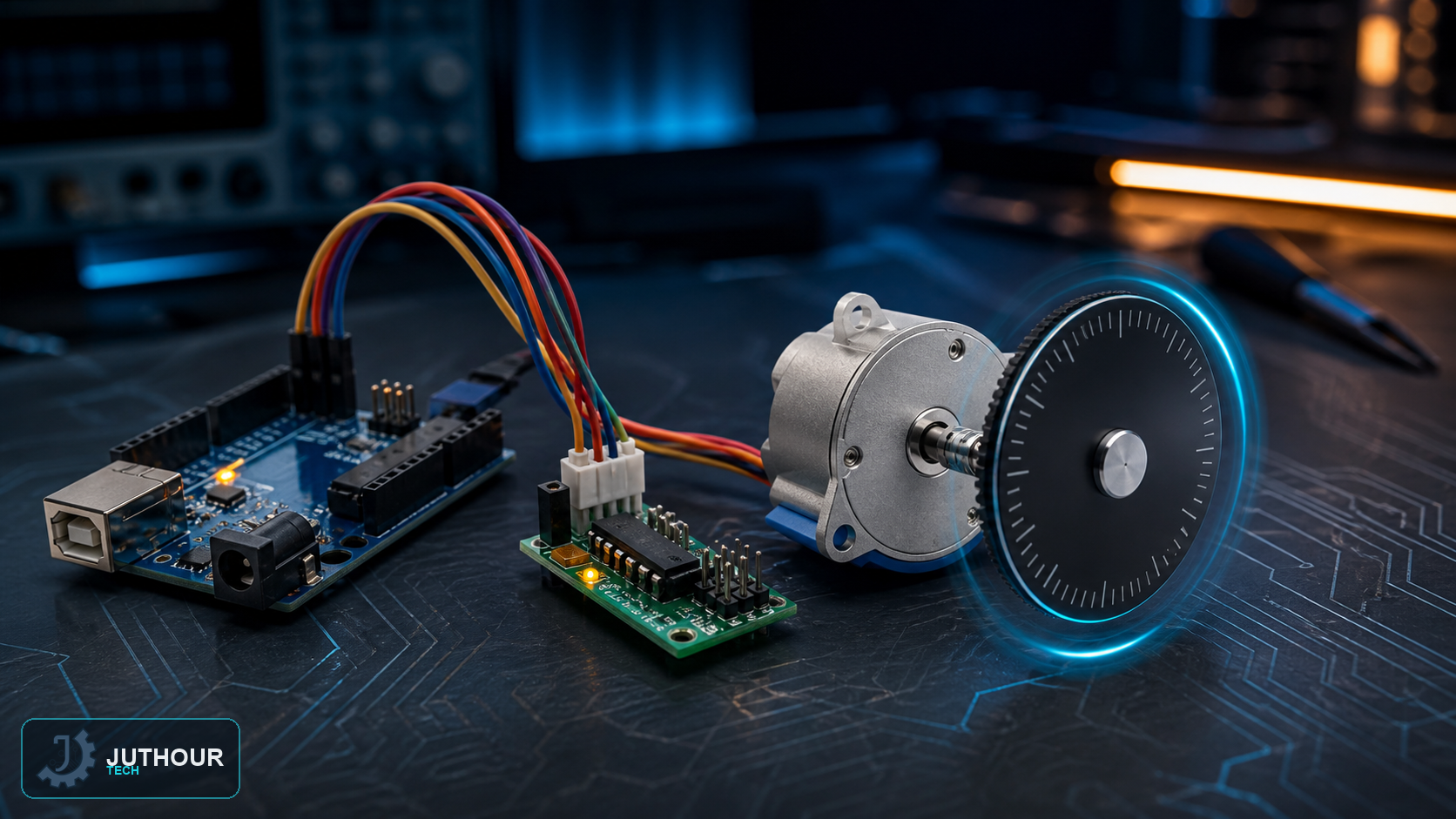
A stepper motor is fundamentally different from a regular DC motor; instead of spinning continuously at a variable speed, a stepper motor moves in precise, discrete angular increments (steps), giving it high positioning accuracy that makes it ideal for applications like CNC machines and 3D printers.
Components needed
An Arduino Uno R3 board, a 28BYJ-48 stepper motor (5V rated), and its commonly bundled ULN2003 driver module.
Wiring it up
The ULN2003 module connects to four digital pins on the Arduino (pins 8 through 11), with each pin controlling one of the motor's four coils, while the motor's connector plugs directly into the driver module's output.
How it works
Unlike regular motors that spin by applying a constant voltage, a stepper motor moves by energizing its four coils in a specific sequential order that produces eight distinct switching states, and each transition between these states moves the motor's shaft by one precise, fixed angular step. The 28BYJ-48 needs about 4096 steps to complete a full 360-degree rotation (due to its internal gear reduction), and the code controls rotation speed by adjusting the delay between each step and the next; direction can also be reversed by reversing the coil activation order. This method provides high positioning accuracy and lets you know the motor's current angle at any moment without needing an additional feedback sensor.
You can find the 28BYJ-48 stepper motor with its ULN2003 driver module at Juthour Tech.
اترك تعليقا