
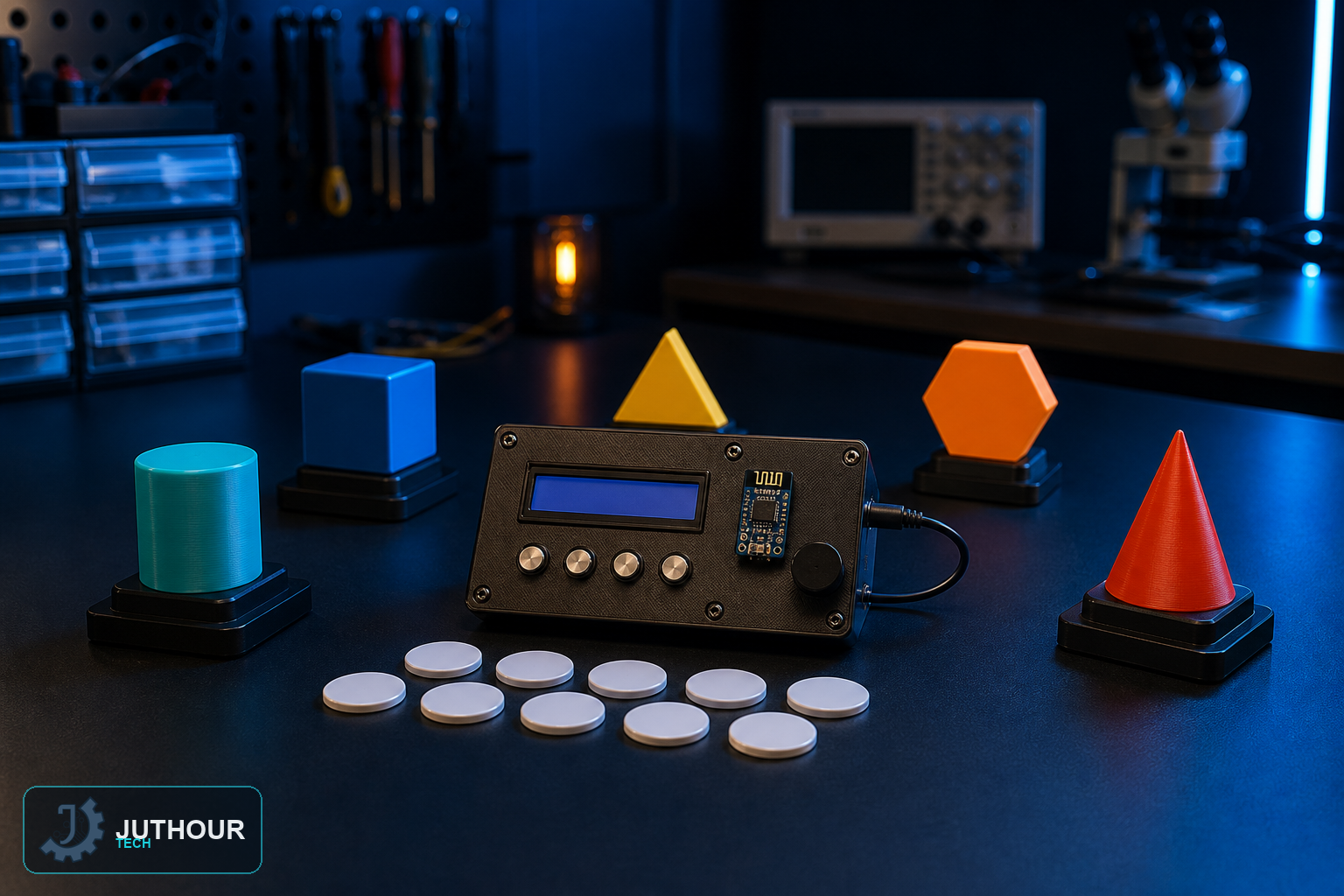
Create a reusable checkpoint game with blank RFID tokens, duplicate-scan protection, offline scoring, reset controls, and accessible feedback.
Prototype objective
The project focuses on sensing, state logic, feedback, and a low-voltage bench prototype that can be tested safely. Define user requirements, success criteria, and failure cases before considering any real deployment.
Suggested components
A Wemos D1 board, a 13.56MHz RFID reader/writer module with team cards, an active buzzer, a breadboard, and jumper wires.
Wiring and implementation
The RFID reader's RST pin connects to D3 and SS pin to D4, with the buzzer on D2.
Use a regulated supply and common ground, never drive loads directly from controller pins, and add current limiting, suitable interface stages, flyback protection for inductive loads, and logic-level conditioning as required.
Test plan
Test every token, duplicate and rapid scans, scoring bounds, reset and recovery, offline play, accessible feedback, battery state, and safe placement of all checkpoints.
Use limitations
Keep the game in a supervised safe area and never hide checkpoints near roads, water, heights, restricted spaces, or private property. Collect minimal participant data.
Next step
Document the schematic, library versions, calibration, measurements, and failure cases. Whenever the application involves safety, health, children, buildings, or equipment, use qualified specialists and applicable standards rather than relying on a hobby prototype.
اترك تعليقا