
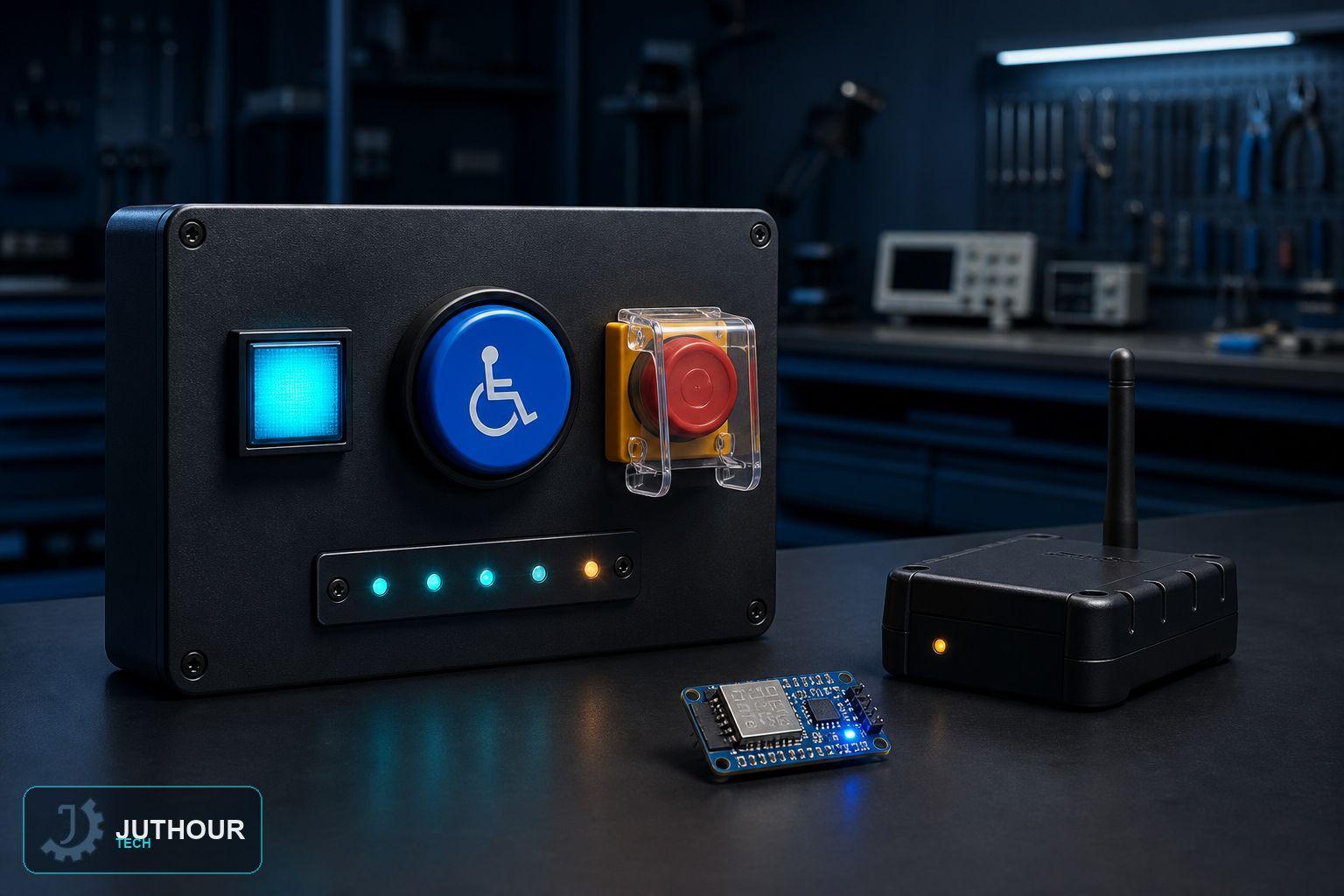
Prototype a large check-in and assistance button with acknowledgement, communication supervision, retry logic, and clear escalation states.
Prototype objective
The project focuses on sensing, state logic, feedback, and a low-voltage bench prototype that can be tested safely. Define user requirements, success criteria, and failure cases before considering any real deployment.
Suggested components
A Wemos-compatible board, a large low-force assistance switch, guarded cancel button, local acknowledgement indicators, supervised communication module, battery monitor, breadboard, and jumper wires.
Wiring and implementation
Connect the assistance and cancel switches to supervised digital inputs with pull-ups, drive indicators through current limiting, monitor supply voltage, and implement acknowledgement and retry without blocking delays.
Use a regulated supply and common ground, never drive loads directly from controller pins, and add current limiting, suitable interface stages, flyback protection for inductive loads, and logic-level conditioning as required.
Test plan
Test debounce, short and long activation, a stuck or disconnected switch, accidental presses, acknowledgement, retry and escalation timing, battery state, network loss, and a local fallback.
Use limitations
This is not a certified lone-worker or emergency system and must not be the only communication path. Real use needs risk assessment, location methods, timed escalation, resilient networks, and trained responders.
Next step
Document the schematic, library versions, calibration, measurements, and failure cases. Whenever the application involves safety, health, children, buildings, or equipment, use qualified specialists and applicable standards rather than relying on a hobby prototype.
اترك تعليقا