
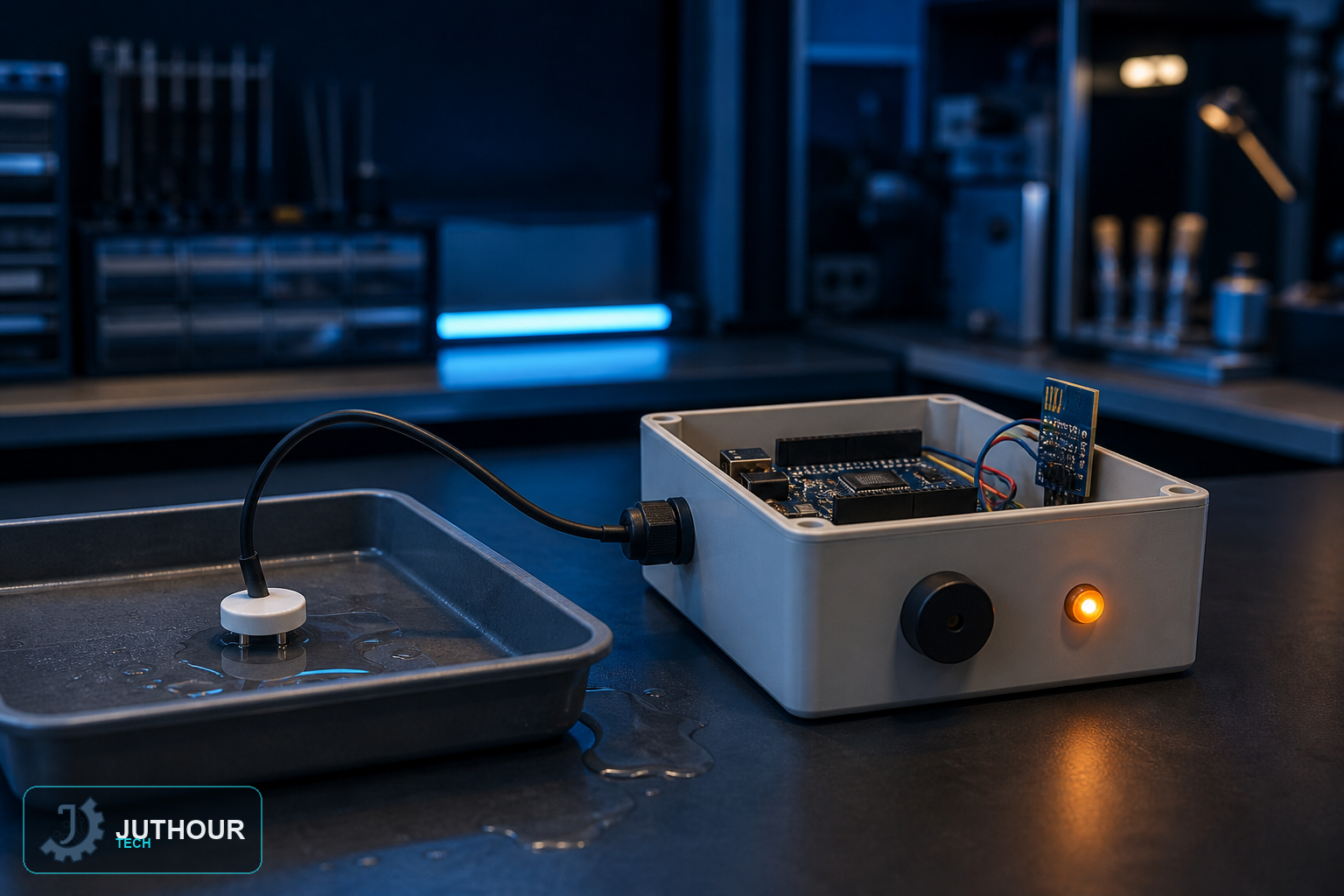
Build a low-voltage floor leak detector with a replaceable probe, local alarm, and optional notification while accounting for corrosion and link failure.
Prototype objective
The project focuses on sensing, state logic, feedback, and a low-voltage bench prototype that can be tested safely. Define user requirements, success criteria, and failure cases before considering any real deployment.
Suggested components
An Arduino Uno, a depth-detection water sensor (3-5V DC), an HC-05 Bluetooth module, a buzzer, a yellow LED, a breadboard, and jumper wires.
Wiring and implementation
The water sensor's digital output connects to pin 2, the buzzer to pin 3, and the LED to pin 4. The HC-05 communicates over software serial through pins 10 and 11 at 9600 baud.
Use a regulated supply and common ground, never drive loads directly from controller pins, and add current limiting, suitable interface stages, flyback protection for inductive loads, and logic-level conditioning as required.
Test plan
Use a shallow tray away from mains wiring. Test droplets, spreading puddles, detergent residue, condensation, drying time, probe corrosion, cable faults, and notification loss.
Use limitations
The alert is not flood prevention and must not control mains power through an exposed hobby circuit. Use proper plumbing, isolation, rated shutoff products, and a local alarm.
Next step
Document the schematic, library versions, calibration, measurements, and failure cases. Whenever the application involves safety, health, children, buildings, or equipment, use qualified specialists and applicable standards rather than relying on a hobby prototype.
اترك تعليقا