
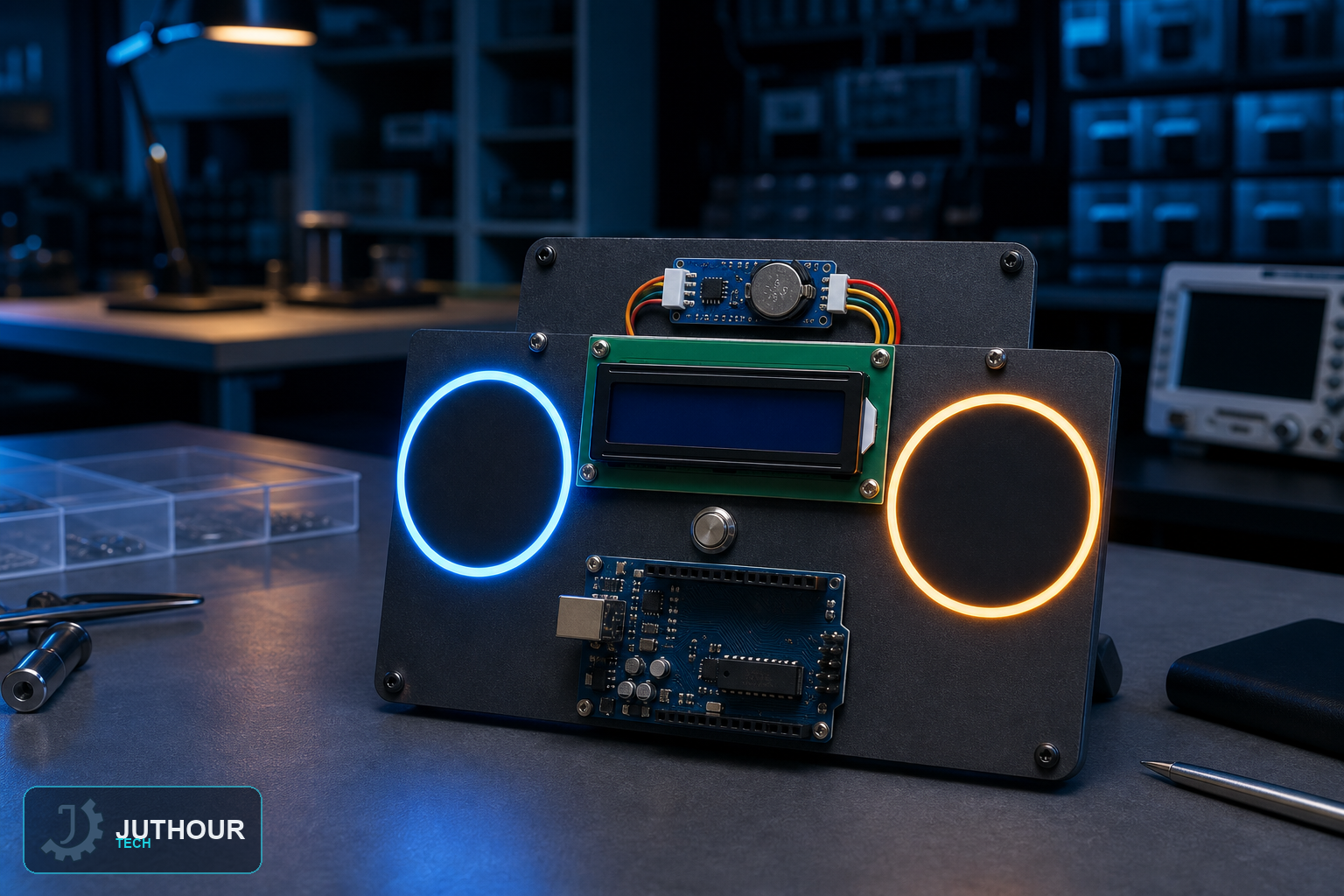
Build a shared, adjustable study timer with clear work and break periods, acknowledgement, and privacy-respecting family follow-up.
Prototype objective
The project focuses on sensing, state logic, feedback, and a low-voltage bench prototype that can be tested safely. Define user requirements, success criteria, and failure cases before considering any real deployment.
Suggested components
An Arduino Uno R3, a DS3231 real-time clock module, a buzzer, a yellow LED, a breadboard, and jumper wires.
Wiring and implementation
The DS3231 connects over I2C, the buzzer to pin 3, and the LED to pin 4.
Use a regulated supply and common ground, never drive loads directly from controller pins, and add current limiting, suitable interface stages, flyback protection for inductive loads, and logic-level conditioning as required.
Test plan
Test timetable editing, pause and resume, missed sessions, power loss, quiet mode, visible progress, data retention, and whether the student can participate in setting goals.
Use limitations
The organizer should support autonomy, not surveillance or punishment. Study duration is not a measure of learning, and schedules should adapt to the student and educator guidance.
Next step
Document the schematic, library versions, calibration, measurements, and failure cases. Whenever the application involves safety, health, children, buildings, or equipment, use qualified specialists and applicable standards rather than relying on a hobby prototype.
اترك تعليقا