
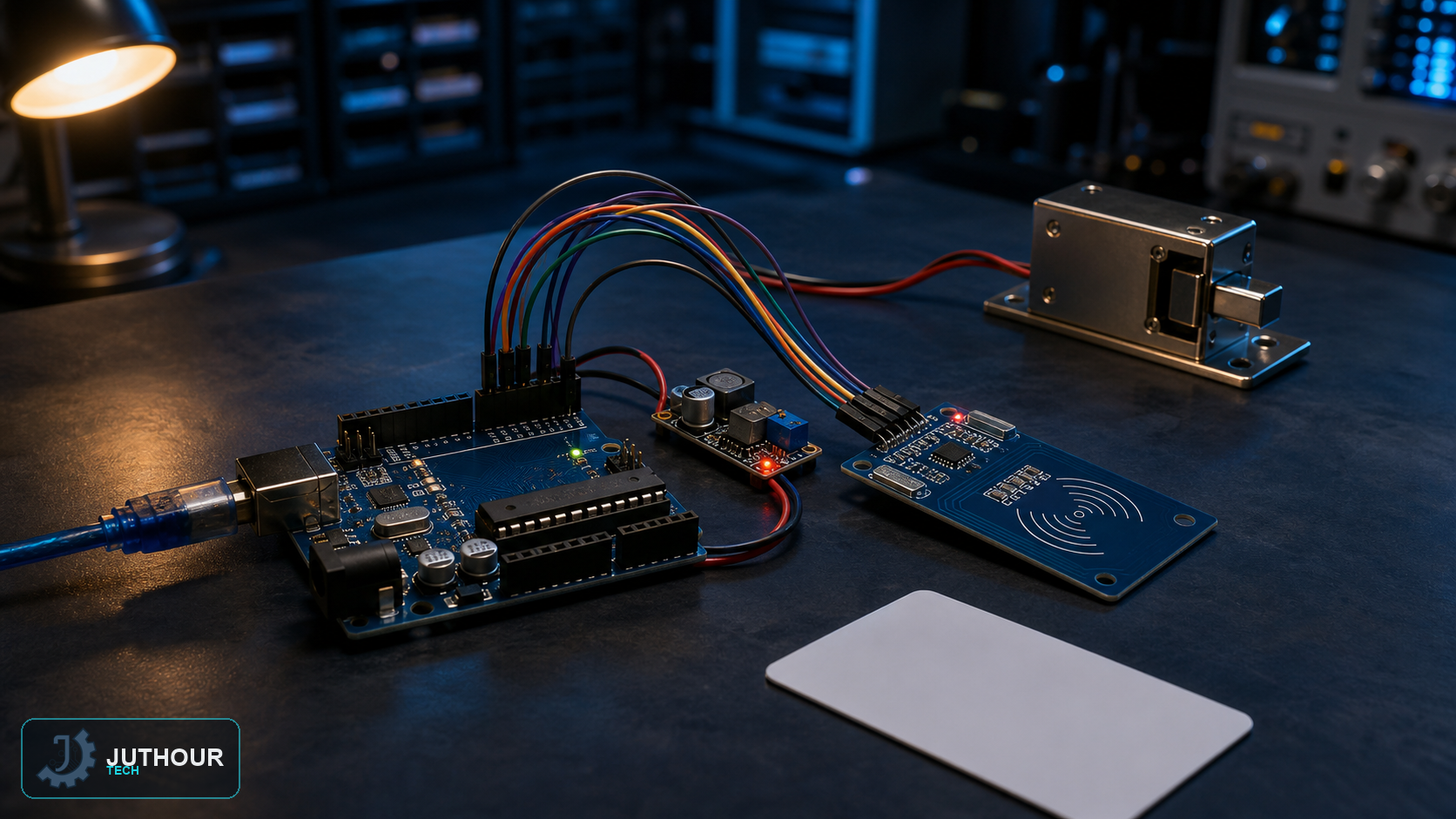
An RFID reader can identify an authorised tag in milliseconds, but a dependable access-control project needs more than comparing card IDs. The reader must be wired at the correct logic voltage, the lock actuator must have a suitable power stage, and the software must fail safely.
Prototype components and SPI wiring
For an Arduino Uno prototype, connect the MFRC522 over SPI: SDA/SS to D10, SCK to D13, MOSI to D11, MISO to D12 and RST to D9. Power the reader from 3.3V and join all grounds. Two LEDs with current-limiting resistors can indicate authorised and rejected scans while the logic is being tested.
Electrical note: the MFRC522 IC is a 3.3V device. Some breakout boards include limited protection, but you should not assume that every module is 5V-tolerant. Check the module documentation and add proper level shifting where required.
Access logic
The sketch reads the UID of each card, compares it with an allow-list, and grants access only on an exact match. Avoid treating the UID as strong security for a high-risk installation: many common tags can be copied. For a real system, log events, limit repeated attempts and combine the card with another factor when the risk justifies it.
Driving a real lock safely
Do not replace an LED by connecting a solenoid or servo directly to the same Arduino pin. A servo normally needs a separate regulated supply with adequate current. A solenoid or electric strike needs a transistor or MOSFET driver, a flyback diode and a correctly rated supply. Connect the supply ground to the Arduino ground, then use the Arduino pin only as a low-current control signal.
Before installing on a door
- Decide whether the lock must fail safe or fail secure during a power cut.
- Add a manual exit method and never block an emergency route.
- Test brownouts, repeated scans and sensor disconnection.
- Enclose the electronics and keep the reader wiring away from actuator noise.
This approach turns a breadboard demonstration into a safer engineering prototype that can later be expanded with multiple users, event logging or remote administration.
اترك تعليقا