
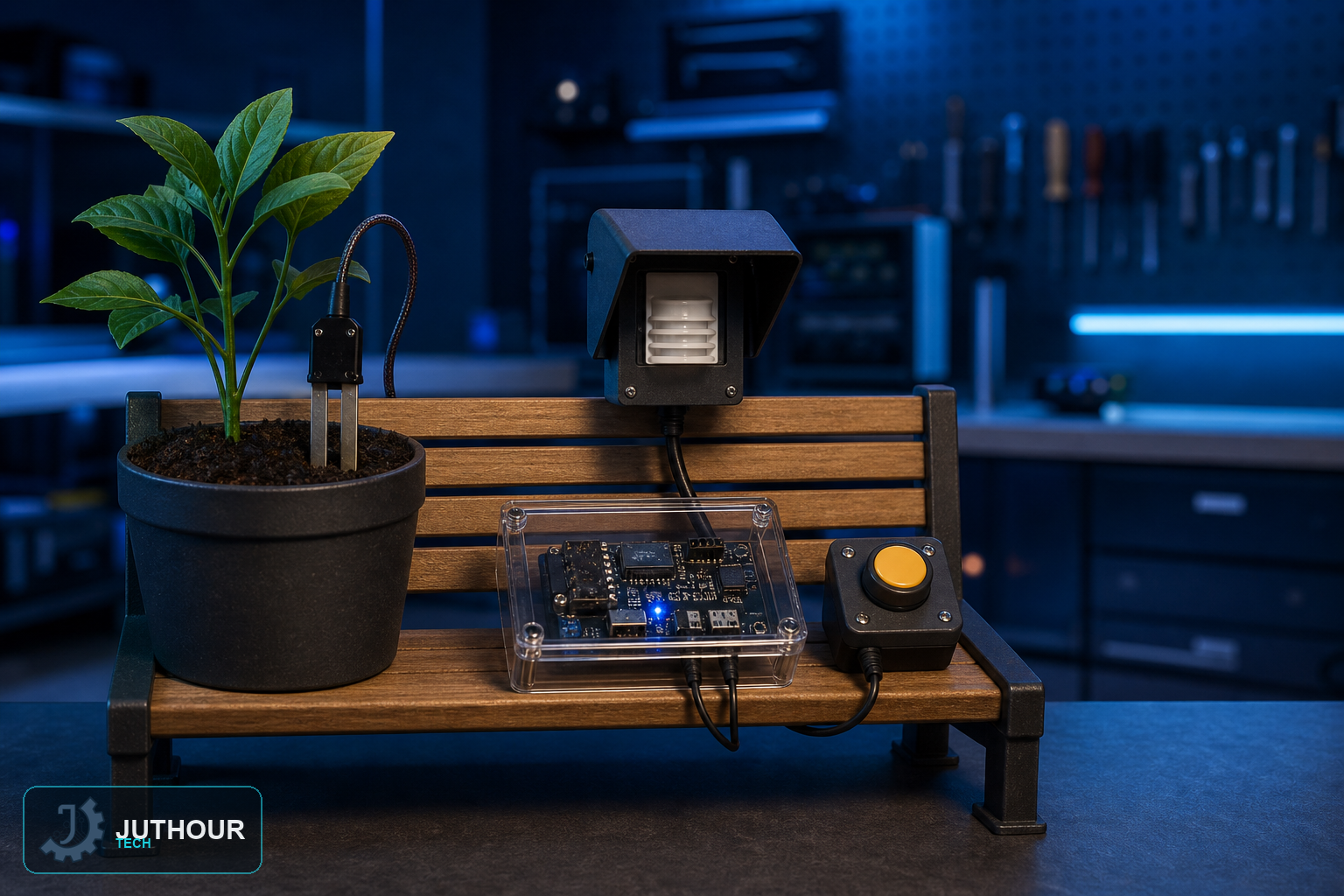
Combine forecast-aware scheduling with soil-moisture checks and user-set quiet times to prompt inspection rather than watering from air temperature alone.
Prototype objective
The project focuses on sensing, state logic, feedback, and a low-voltage bench prototype that can be tested safely. Define user requirements, success criteria, and failure cases before considering any real deployment.
Suggested components
A Wemos-compatible board, a capacitive soil-moisture probe for a potted test sample, an SHT31-class weather-shielded sensor, acknowledgement button, local indicator, breadboard, and jumper wires.
Wiring and implementation
Connect the capacitive soil sensor to a supported analog input and calibrate it in the intended soil, connect the SHT31 over I2C, and use readings only to prompt inspection rather than directly operating a pump.
Use a regulated supply and common ground, never drive loads directly from controller pins, and add current limiting, suitable interface stages, flyback protection for inductive loads, and logic-level conditioning as required.
Test plan
Test schedule editing, acknowledgement, snooze, quiet hours, missed prompts, clock rollover, power recovery, privacy, and whether the user can easily change or disable every cue.
Use limitations
Air temperature does not determine irrigation need. Plant species, soil, root depth, local restrictions, rainfall, and drainage matter; inspect the soil and follow local water guidance.
Next step
Document the schematic, library versions, calibration, measurements, and failure cases. Whenever the application involves safety, health, children, buildings, or equipment, use qualified specialists and applicable standards rather than relying on a hobby prototype.
اترك تعليقا