
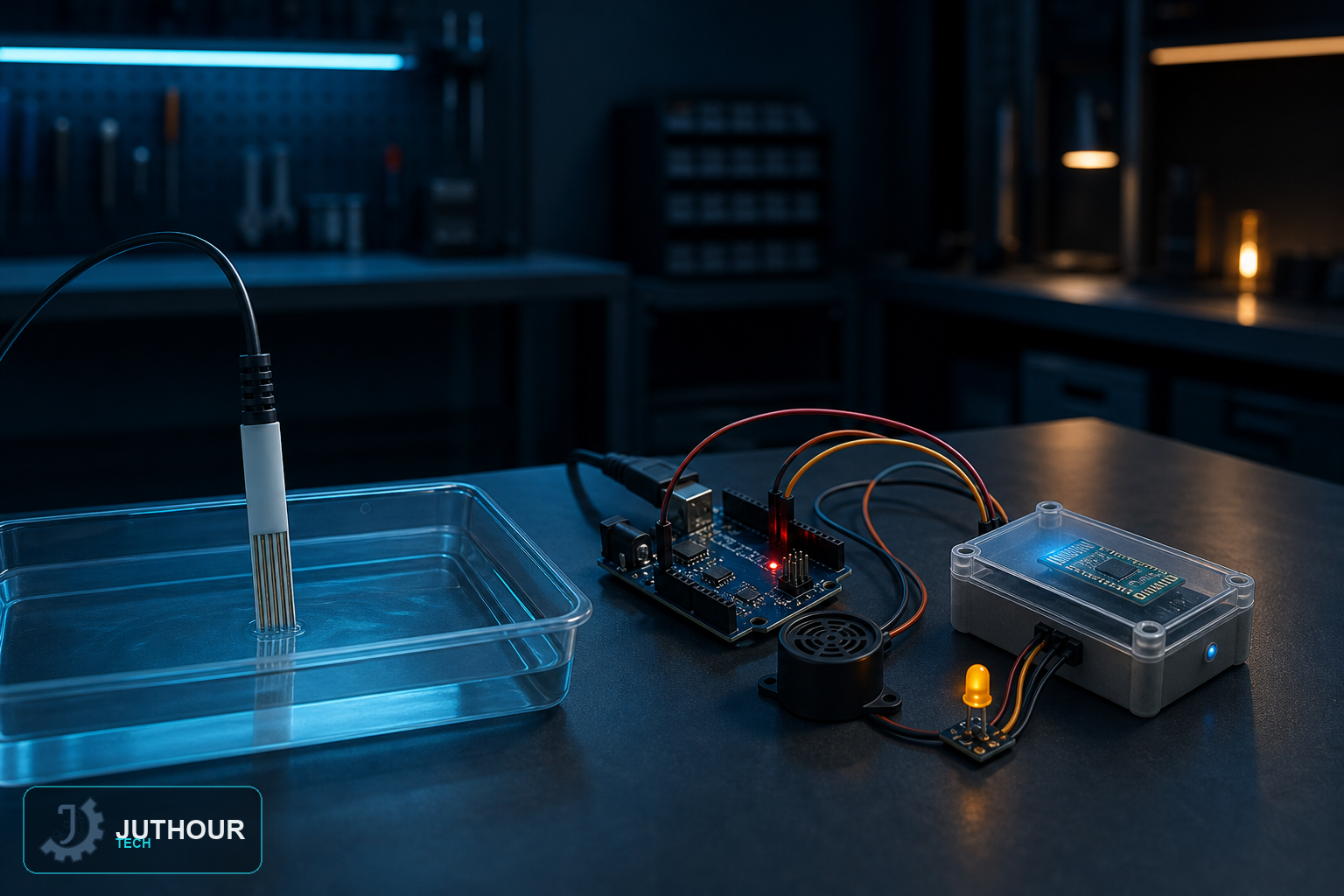
Build a bench-top leak detector with a contact probe, local indicators, and an HC-05 notification while accounting for corrosion and Bluetooth range.
Prototype objective
This project focuses on measurement, state logic, feedback, and a low-voltage bench prototype that can be tested safely before any more advanced application is considered.
Suggested components
An Arduino Uno, a contact-type water leak sensor probe, an active buzzer, an LED, an HC-05 Bluetooth module, a breadboard, and jumper wires.
Wiring and implementation
The leak sensor's output connects to an analog input, the buzzer and LED each connect to their own digital output pins, and the HC-05 connects over serial.
Use a regulated supply and common ground, drive loads through suitable interface stages, add flyback protection for inductive loads, and condition logic levels where required.
Test plan
Calibrate with dry, damp, and immersed states; test false alarms from condensation, inspect electrode corrosion, and verify that a lost phone link does not disable the local alarm.
Use limitations
This is a convenience prototype, not a certified flood-protection system. Use corrosion-resistant sensing or replaceable probes, isolate all low-voltage electronics from wet areas, and retain an independent local alarm.
Next step
Document the schematic, library versions, measurements, and failure cases before extending the prototype, and consult qualified specialists and applicable standards whenever safety, health, vehicles, or industrial equipment are involved.
اترك تعليقا