
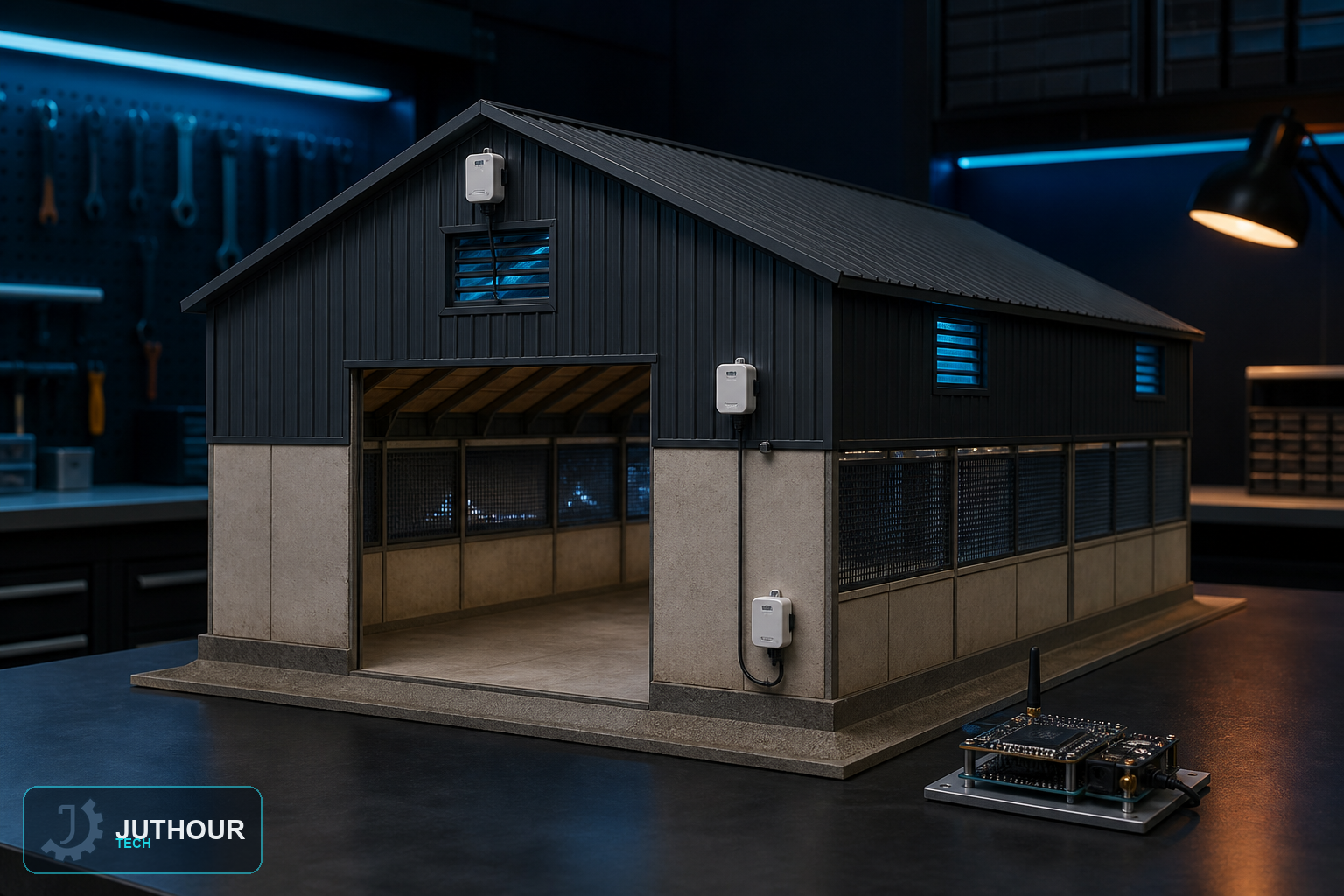
Log temperature and humidity at several model locations and explore sensor placement, ventilation trends, local alarms, and network-failure behavior.
Prototype objective
The project focuses on sensing, state logic, feedback, and a low-voltage bench prototype that can be tested safely. Define user requirements, success criteria, and failure cases before considering any real deployment.
Suggested components
An Arduino- or Wemos-compatible controller as appropriate, an SHT31-class temperature and humidity sensor, a ventilated shield or enclosure, local indicator, optional low-voltage actuator for ventilation demonstrations, breadboard, and jumper wires.
Wiring and implementation
Connect the SHT31 over I2C at the voltage specified by its manufacturer and place it away from board heat where it represents the measured environment. Drive any fan or servo from a suitable supply and interface with manual override and a safe fault state.
Use a regulated supply and common ground, never drive loads directly from controller pins, and add current limiting, suitable interface stages, flyback protection for inductive loads, and logic-level conditioning as required.
Test plan
Compare readings with a calibrated reference at several conditions, evaluate sensor placement and stabilization, test threshold hysteresis, logging gaps, sensor faults, power loss, and notification failure.
Use limitations
Environmental readings alone do not establish animal comfort or welfare. Species, age, stocking density, airflow, bedding, gases, water, and veterinary guidance all matter.
Next step
Document the schematic, library versions, calibration, measurements, and failure cases. Whenever the application involves safety, health, children, buildings, or equipment, use qualified specialists and applicable standards rather than relying on a hobby prototype.
اترك تعليقا