
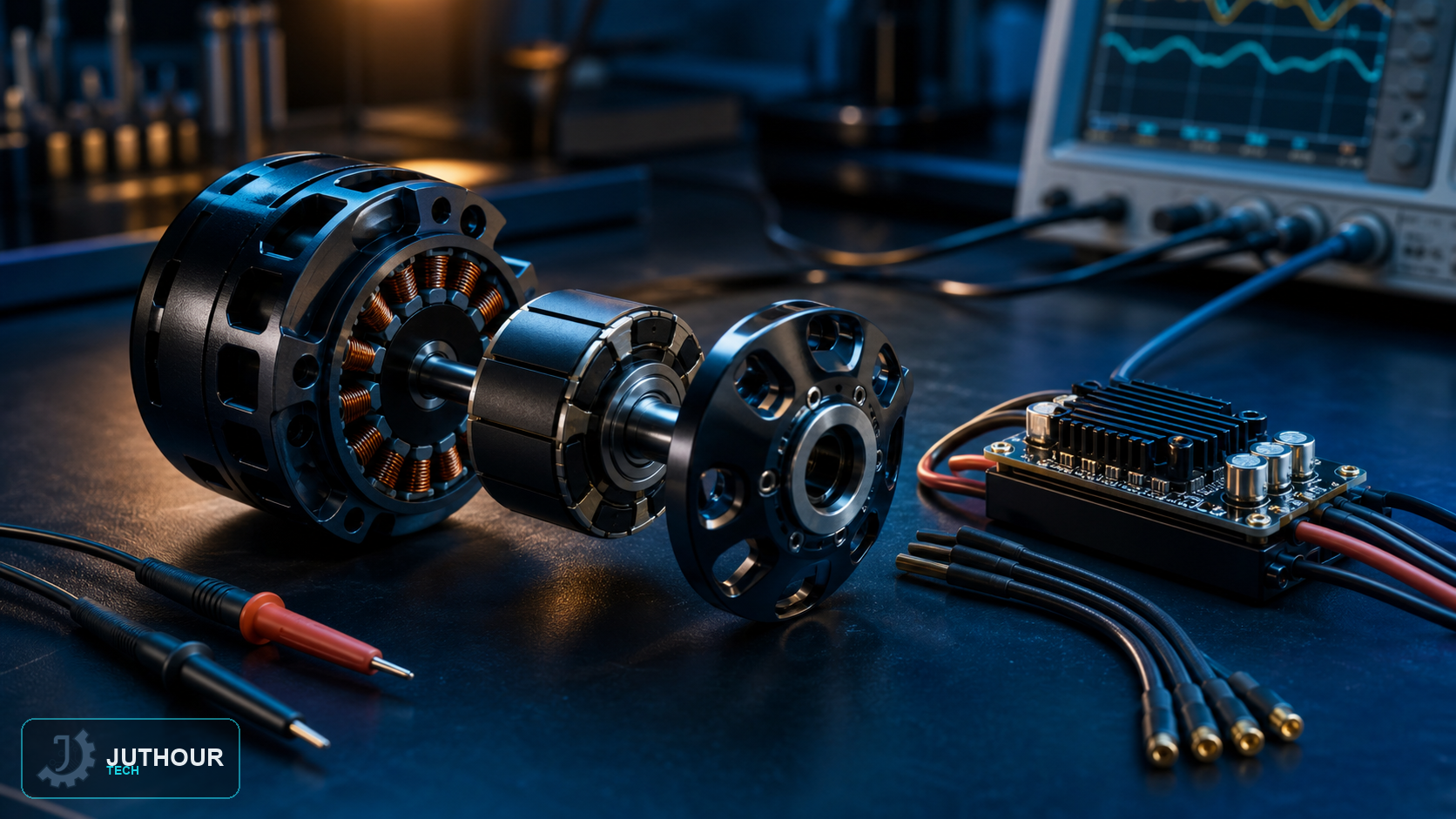
A brushless DC (BLDC) motor gets rid of the physical brushes that wear out in traditional DC motors, replacing them with electronic control that switches the windings on and off in sequence to keep the rotor spinning.
How it turns without brushes
A BLDC motor has three output wires, one per phase in a three-phase system. An Electronic Speed Controller (ESC) converts the battery's DC voltage into precisely timed pulses distributed across those three phases — at any given instant, only two of the three are actually energized, with current flowing in through one and out through another. As each pair energizes in sequence, the rotor's permanent magnets are pulled to align with the active coils, producing continuous rotation.
In-runner vs. out-runner
Two mechanical layouts exist: in-runner motors spin an internal shaft while the outer housing stays fixed, while out-runner motors flip that arrangement, with the outer housing itself doing the spinning around a fixed internal shaft — the layout common in most drone motors.
Sensored vs. sensorless
Knowing the rotor's exact position is what lets the ESC energize the right phase at the right moment. Sensored motors use Hall-effect sensors to track that position directly; sensorless motors skip the extra sensors and instead infer position from the back-EMF voltage the spinning motor itself generates in its unpowered phase.
Why drones rely on them
BLDC motors dominate multirotor drones for a combination of reasons: a strong power-to-weight ratio, smooth vibration-free spin that keeps the airframe stable, and the ability to change torque quickly — essential for the rapid throttle response takeoff, landing, and stabilization all demand.
What the ESC actually does
The ESC synthesizes the motor phase currents from a DC supply and commutates them in the required sequence. Control may use six-step commutation, sinusoidal drive, or field-oriented control, so “two phases energized” is not universal. A battery-eliminator circuit is also not present on every ESC; check the controller specification before using it to power the flight controller or microcontroller.
You can find BLDC motors and ESCs at Juthour Tech.
اترك تعليقا