
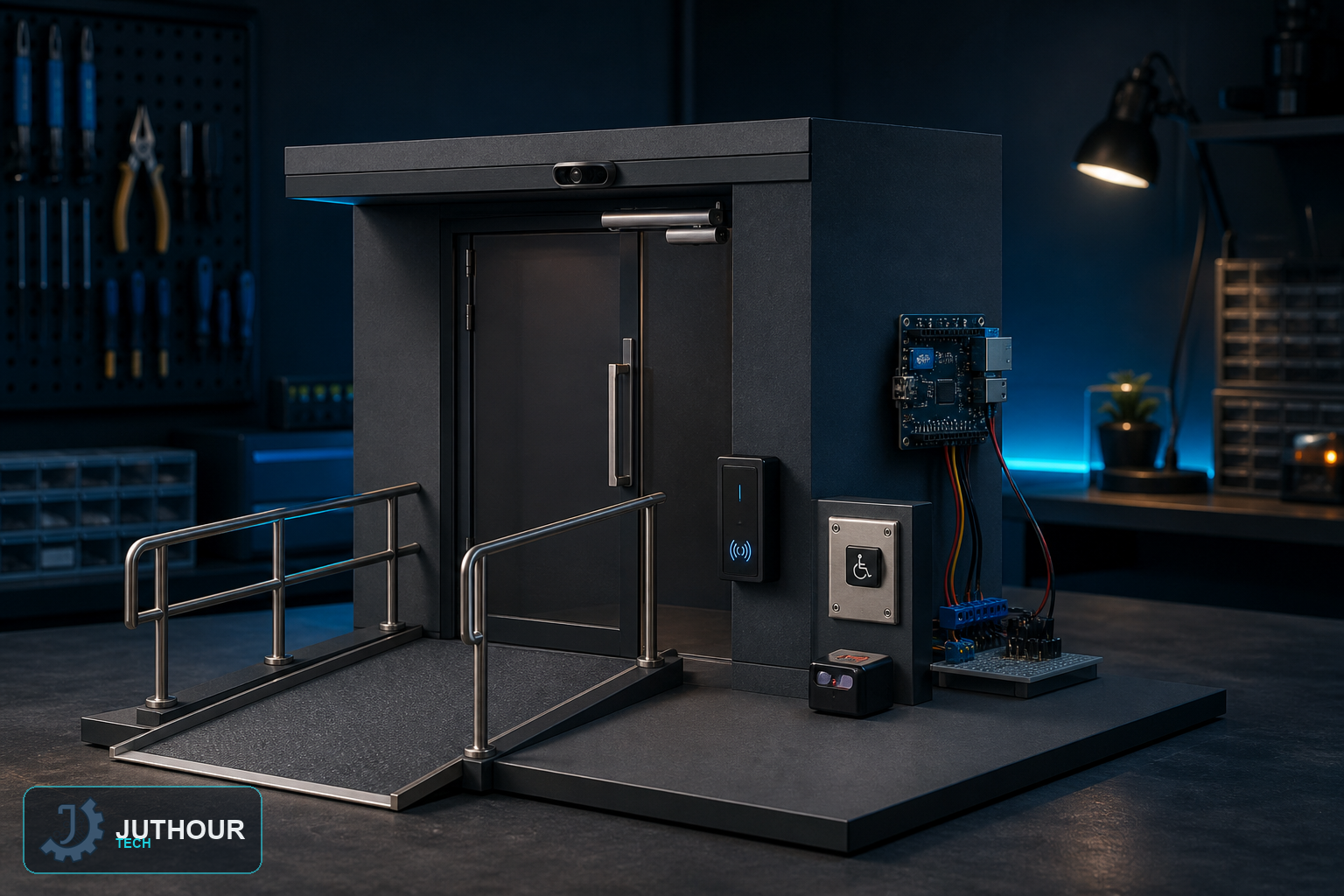
Evaluate credential reach, door timing, obstruction response, alternative controls, and manual assistance on a tabletop building-entry model.
Prototype objective
The project focuses on sensing, state logic, feedback, and a low-voltage bench prototype that can be tested safely. Define user requirements, success criteria, and failure cases before considering any real deployment.
Suggested components
A Wemos-compatible board, an RC522-class RFID reader with blank tokens, a miniature accessible door operator, obstruction sensor, low assistance control, local feedback, breadboard, and jumper wires.
Wiring and implementation
Connect the RFID reader over its documented 3.3 V SPI interface, drive the miniature operator from a suitable separate supply, and wire the obstruction and low assistance controls to supervised inputs with clear feedback.
Use a regulated supply and common ground, never drive loads directly from controller pins, and add current limiting, suitable interface stages, flyback protection for inductive loads, and logic-level conditioning as required.
Test plan
Test valid and revoked credentials, reach and feedback, obstruction, actuator jam, repeated requests, network and power loss, manual release, emergency egress, and accessible alternatives.
Use limitations
Access to a building is broader than opening one door. Deployment must meet accessibility and fire codes, provide routes and lifts where required, and include secure rated hardware.
Next step
Document the schematic, library versions, calibration, measurements, and failure cases. Whenever the application involves safety, health, children, buildings, or equipment, use qualified specialists and applicable standards rather than relying on a hobby prototype.
اترك تعليقا