
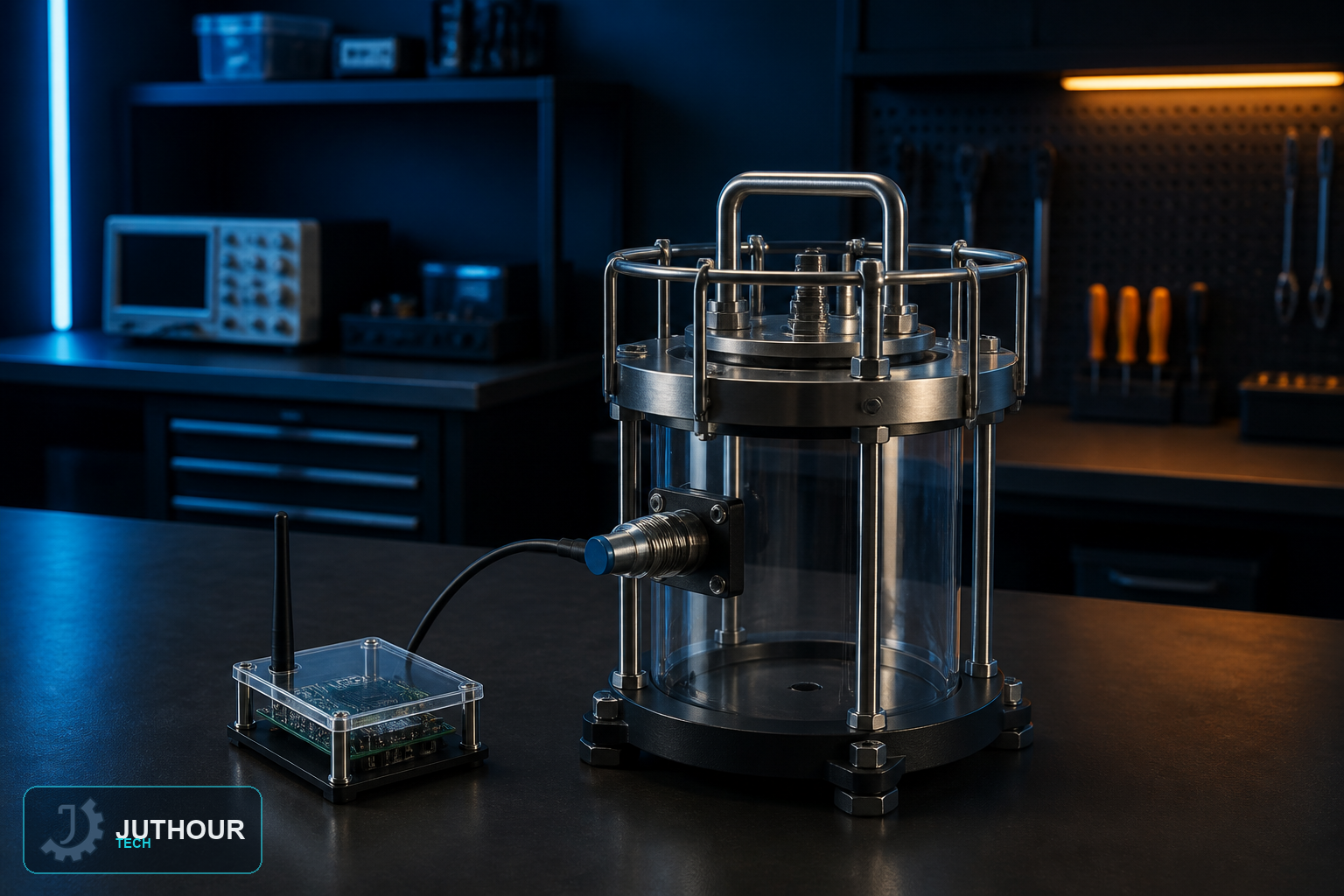
Measure level changes on a sealed well model with a non-contact sensor and trend logging while documenting echo, condensation, and installation limits.
Prototype objective
The project focuses on sensing, state logic, feedback, and a low-voltage bench prototype that can be tested safely. Define user requirements, success criteria, and failure cases before considering any real deployment.
Suggested components
A Wemos-compatible board, a non-contact distance sensor mounted outside a sealed level model, local indicator, optional data logger, breadboard, and jumper wires.
Wiring and implementation
Mount the non-contact sensor above the sealed model and outside the guard. Condition any 5 V echo before a 3.3 V Wemos input, filter readings, and keep a local fault indicator independent of Wi-Fi.
Use a regulated supply and common ground, never drive loads directly from controller pins, and add current limiting, suitable interface stages, flyback protection for inductive loads, and logic-level conditioning as required.
Test plan
Test empty, partial, and full states with uneven and angled targets; record blind zones, condensation, dust or splashes, stale readings, sensor faults, power loss, and communication failure.
Use limitations
Never enter or work over an open well for this prototype. It cannot declare drought, water quality, or safe yield; real wells require guarded access and qualified hydrogeological assessment.
Next step
Document the schematic, library versions, calibration, measurements, and failure cases. Whenever the application involves safety, health, children, buildings, or equipment, use qualified specialists and applicable standards rather than relying on a hobby prototype.
اترك تعليقا