
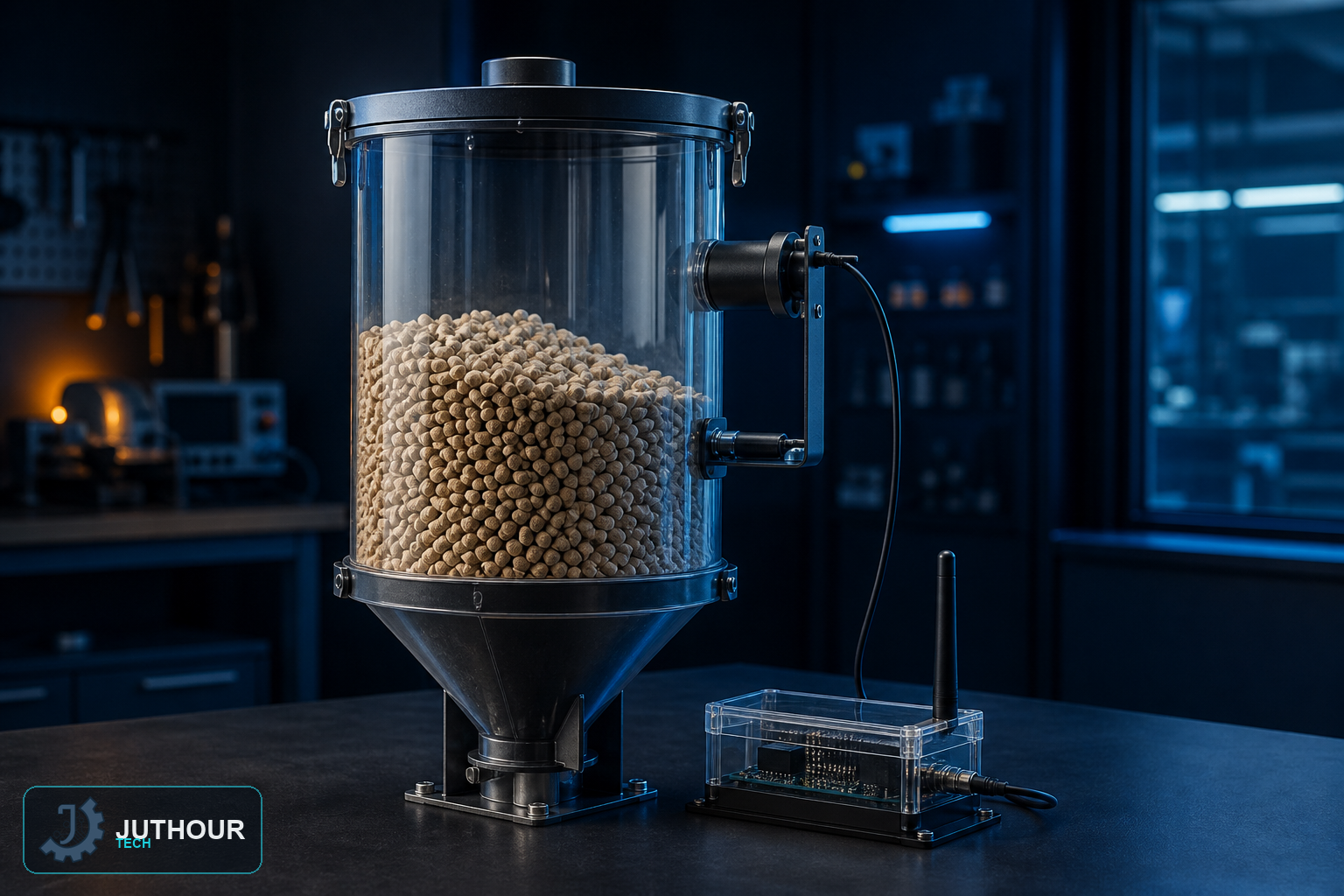
Estimate level on a sealed feed-bin model with non-contact sensing while studying uneven surfaces, dust, blind zones, condensation, and data loss.
Prototype objective
The project focuses on sensing, state logic, feedback, and a low-voltage bench prototype that can be tested safely. Define user requirements, success criteria, and failure cases before considering any real deployment.
Suggested components
A Wemos D1 board, an HC-SR04 ultrasonic sensor, an active buzzer, a breadboard, and jumper wires.
Wiring and implementation
The HC-SR04's Trig pin connects to D3 and Echo to D4, with the buzzer on D2.
Use a regulated supply and common ground, never drive loads directly from controller pins, and add current limiting, suitable interface stages, flyback protection for inductive loads, and logic-level conditioning as required.
Test plan
Test empty, partial, and full states with uneven and angled targets; record blind zones, condensation, dust or splashes, stale readings, sensor faults, power loss, and communication failure.
Use limitations
A single distance reading cannot prove feed quantity or quality. Dust can be hazardous; real bins need suitable certified instruments, safe access, calibration, and feed-management practice.
Next step
Document the schematic, library versions, calibration, measurements, and failure cases. Whenever the application involves safety, health, children, buildings, or equipment, use qualified specialists and applicable standards rather than relying on a hobby prototype.
اترك تعليقا