
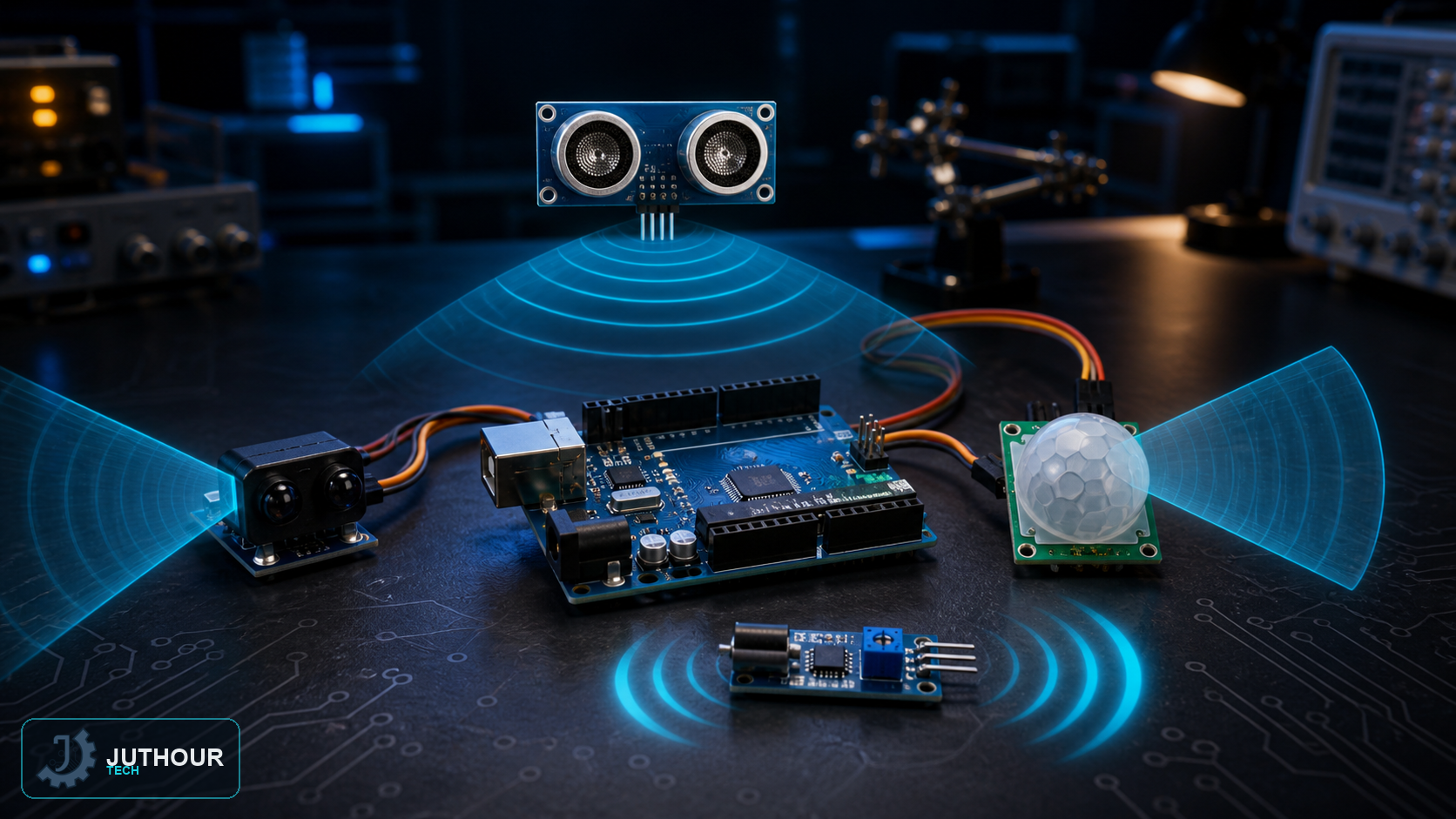
This quick guide continues our series on getting to know Arduino sensors, with five common sensors most of which we've covered in detail before.
HC-SR04 Ultrasonic Sensor
Works on an echolocation principle similar to how bats navigate, sending ultrasonic waves and receiving their reflection to determine distance across a 2-400cm range — we built a radar project and an obstacle-avoidance robot on it in standalone articles.
Soil Moisture Sensor
Measures soil moisture by passing current through it — wet soil lowers the read voltage while dry soil raises it — making it the basis of automatic irrigation systems, which we detailed in a standalone article with NodeMCU.
Sound Sensor
Uses a microphone to pick up ambient noise and converts air vibrations into an electrical signal via a carbon-based component, better suited to detecting the general presence of sound than analyzing it precisely — we built an LED-control project on it in a standalone article.
MQ2 Gas Sensor
Detects flammable gases such as methane, propane, and hydrogen, used mainly in home-safety systems to catch dangerous gas leaks — we detailed its full wiring in a standalone article.
TCS3200 Color Recognition Sensor
Distinguishes between different colors by analyzing the frequency of reflected light, converting color intensity into varying frequencies, opening the door to sorting and quality-control applications — we detailed this in a standalone article.
You can find all of these sensors at Juthour Tech.
اترك تعليقا