
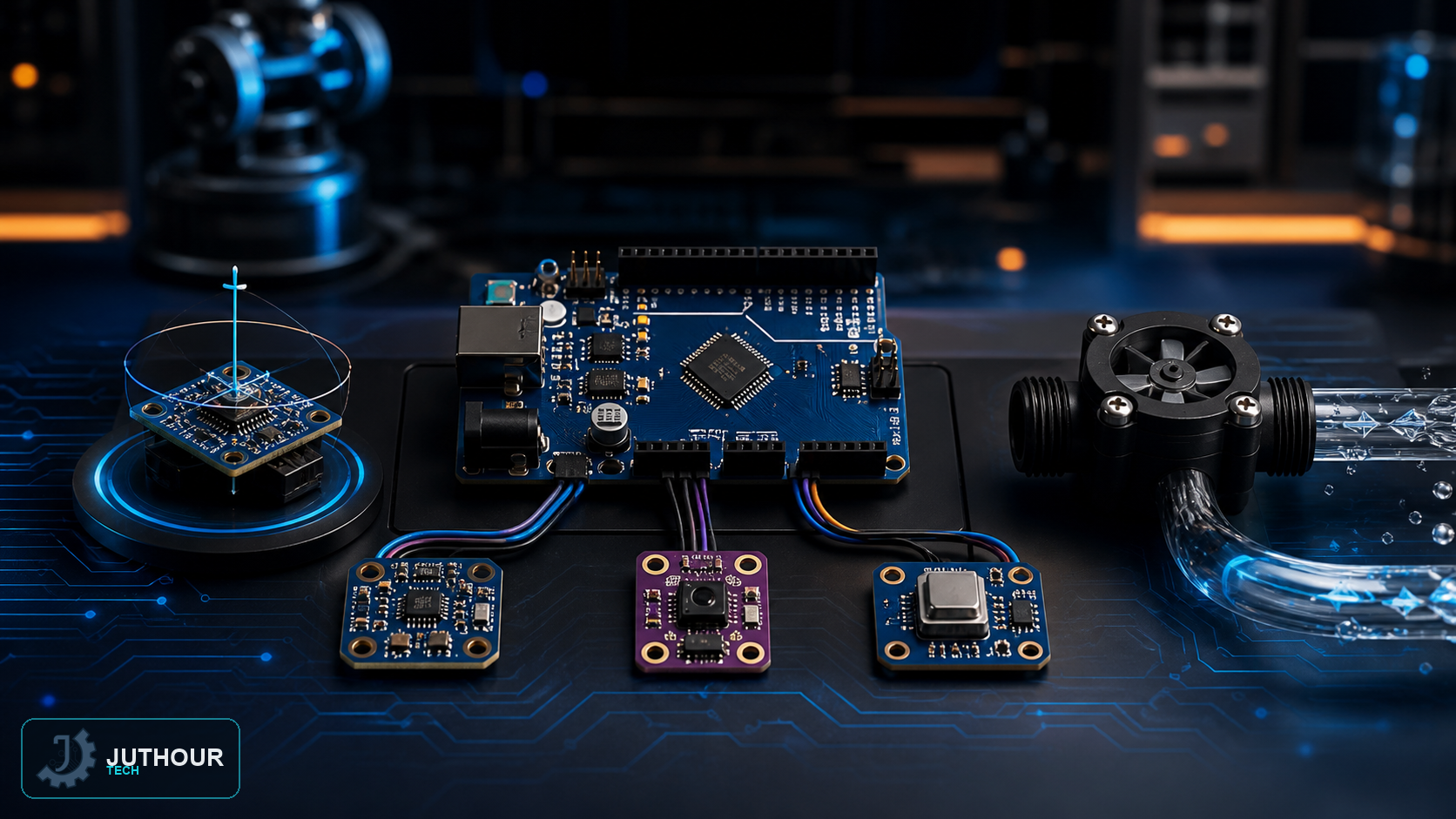
This guide continues our tour of the Arduino sensor world with five more types — some we've covered in standalone articles before, and others that are less common but open the door to entirely different projects.
YF-S201 Water Flow Sensor
Measures liquid flow rate inside pipes via a spinning impeller and a Hall-effect sensor, across a 1-30 liter-per-minute range at 5-18V operating voltage, with an output frequency proportional to flow speed — we covered building a full automatic water dispenser based on it in a standalone article.
801S Vibration Sensor
Detects shock and vibration in multiple directions with no fixed directional constraint, with adjustable sensitivity and a digital output, typically used to monitor equipment and detect any abnormal vibration that might signal an impending fault — a principle similar to what we covered earlier with the SW-420 sensor.
KY-039 Heart Rate Pulse Sensor
Combines an infrared LED with a receiving phototransistor, measuring the change in light absorption through a fingertip with each heartbeat, allowing real-time heart-rate measurement. This sensor opens the door to simple health-monitoring projects that can connect to a display or phone app.
Hall Effect Magnetic Sensor
Outputs an analog voltage that varies with the strength of the surrounding magnetic field. While not a precision measurement tool, it excels at detecting a magnet-equipped object passing by and estimating its relative position, making it useful in rotation counters and magnetic door-opening detection systems.
DSM501A Dust Sensor
Relies on infrared light and optical components arranged at an angle inside an enclosed chamber to count suspended particles like dust and smoke, making it suitable for relatively low-cost air-quality and pollution (PM2.5) monitoring projects.
You can find all of these sensors at Juthour Tech.
اترك تعليقا