
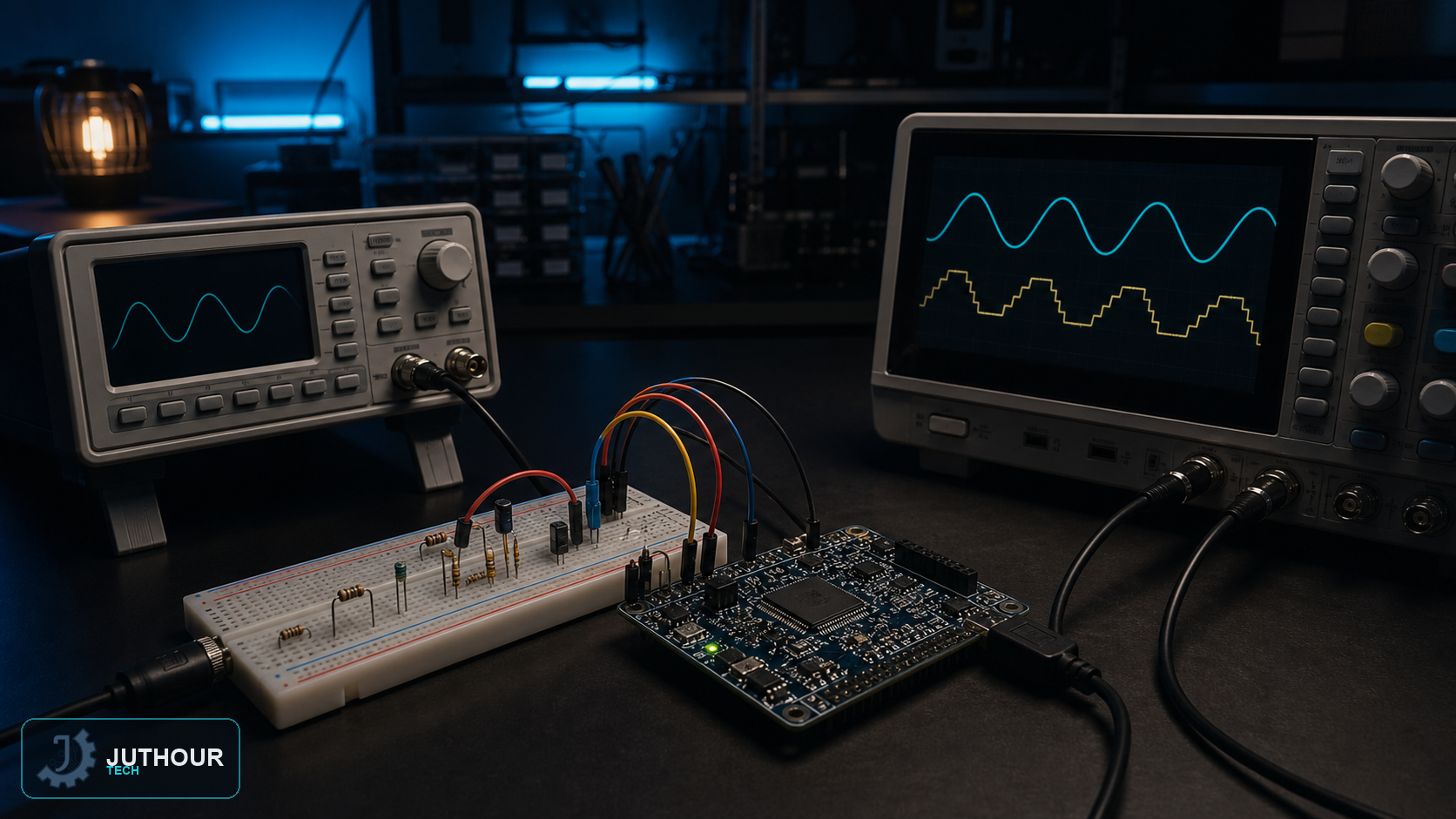
Every analogRead() call in an Arduino sketch leans on a piece of hardware doing real work behind the scenes: an analog-to-digital converter, translating the continuous, real-world voltages a sensor produces into the discrete numbers a microcontroller can actually process.
What it bridges
The physical world — temperature, light, sound, pressure — is continuous, while a microcontroller only understands binary numbers. An ADC handles the middle step, but only for voltage: any other physical quantity has to be converted to a voltage first, which is exactly the job sensors like thermistors or LDRs do before the signal ever reaches the ADC.
Resolution: how the range is divided
A 10-bit converter produces codes 0 through 1023, representing 1024 quantization levels. The ideal LSB size is Vref/1024, while the exact end-point voltage formula depends on the converter definition and rounding convention.
Channels
A "channel" is simply one pin capable of taking an analog reading. A board with six analog channels can read six independent analog voltages, each converted separately.
Reference voltage and input limits
The reference defines the measurement range but does not override the microcontroller pin absolute maximum. Use a divider, series resistance, and protection as appropriate, and measure the real reference or use a more accurate reference when the application needs it.
Doing the math
On a 10-bit ADC with a 5V reference, an actual input of 4V converts to a digital reading of roughly 820. Going the other direction — from a raw reading back to a real voltage — uses the formula: voltage = (digital reading × reference voltage) ÷ resolution.
The practical limit
A standard ADC simply can't measure a voltage higher than the microcontroller's own operating voltage. Reading anything above that — say, a 12V source with a 5V-powered Arduino — needs a voltage divider circuit first to scale it down into a safe, measurable range.
You can find Arduino boards and sensor modules at Juthour Tech.
اترك تعليقا