
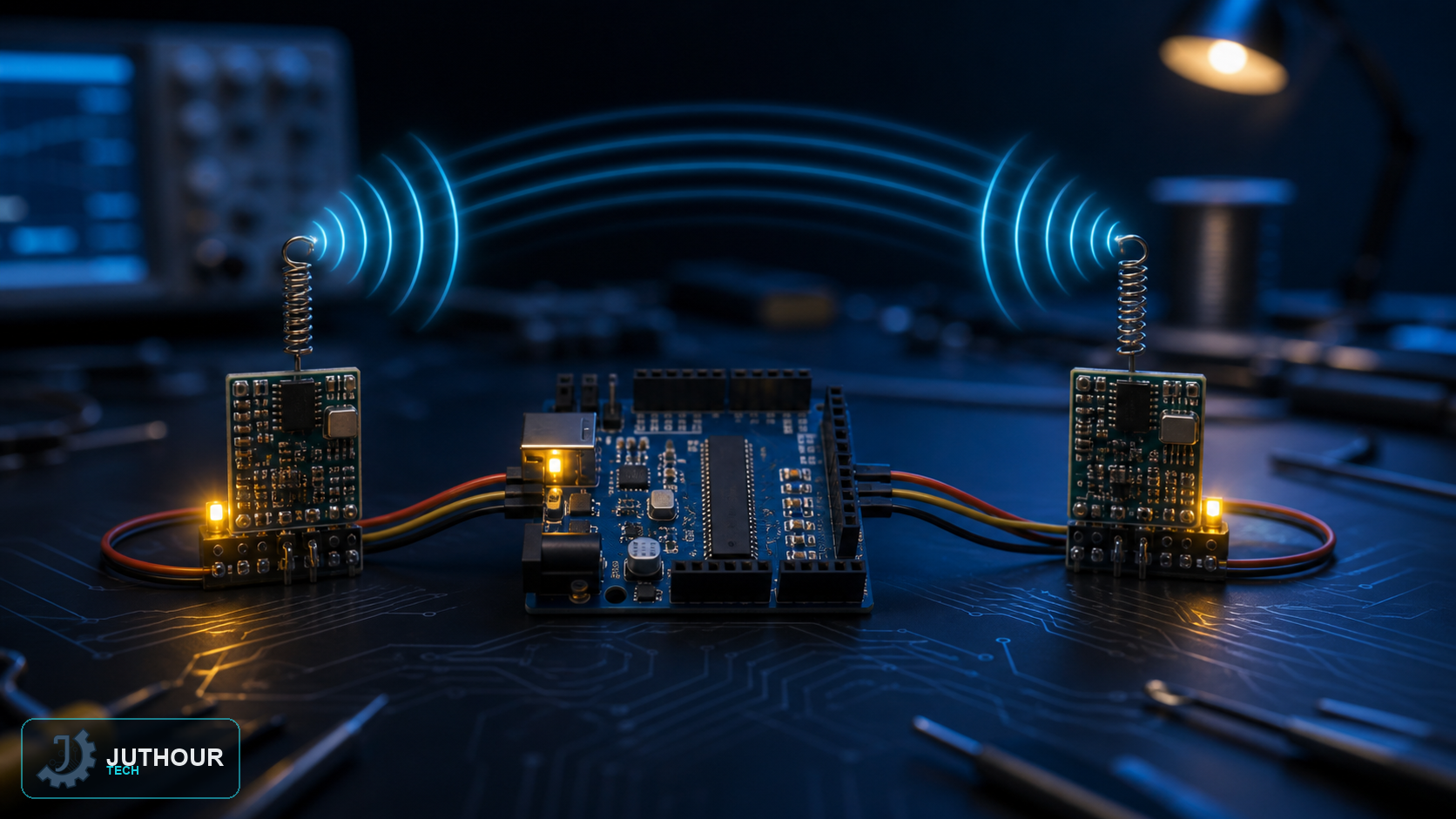
433MHz transmitter and receiver modules offer a simple, low-cost wireless communication method, with no complex pairing like Bluetooth or any network structure like WiFi.
How it works: amplitude shift keying
These modules rely on a modulation technique known as ASK (Amplitude Shift Keying), where the carrier wave's strength toggles on and off according to the input digital signal: when the data pin receives a HIGH signal, the transmitter generates a 433MHz carrier wave, while the wave stops on a LOW signal. The receiver picks up this modulated signal via a tuning and amplification circuit, then a phase-locked loop (PLL) extracts the original digital data from the carrier wave.
Wiring it up
Both the transmitter and receiver need just three pins: the transmitter needs VCC (between 3.5 and 12V), GND, and a DATA pin (digital pin 12 in the common example), while the receiver needs VCC (5V), GND, and a DATA output pin (digital pin 11). The transmitter's supply voltage directly affects the transmitted signal strength and effective range.
Programming it
The project relies on the RadioHead ASK library, which spares the programmer the complexity of modulation and demodulation: the transmitter sends data via rf_driver.send(), while the other end receives it via rf_driver.recv(), with the library handling the entire encoding and decoding process automatically. ASK's main advantage lies in its simplicity and low bandwidth requirements, at the cost of being more susceptible to interference than other modulation techniques.
You can find 433MHz RF modules at Juthour Tech.
اترك تعليقا